
A radiopharmaceutical is cleared by the kidneys so quickly that its biological half-life is only a fraction of its physical half-life. Two colleagues are discussing how long the activity actually stays in the patient, and they disagree about how the three half-lives relate. Which statement correctly compares physical, biological, and effective half-life for this tracer?
Select an answer to reveal the explanation.
Short Explanation
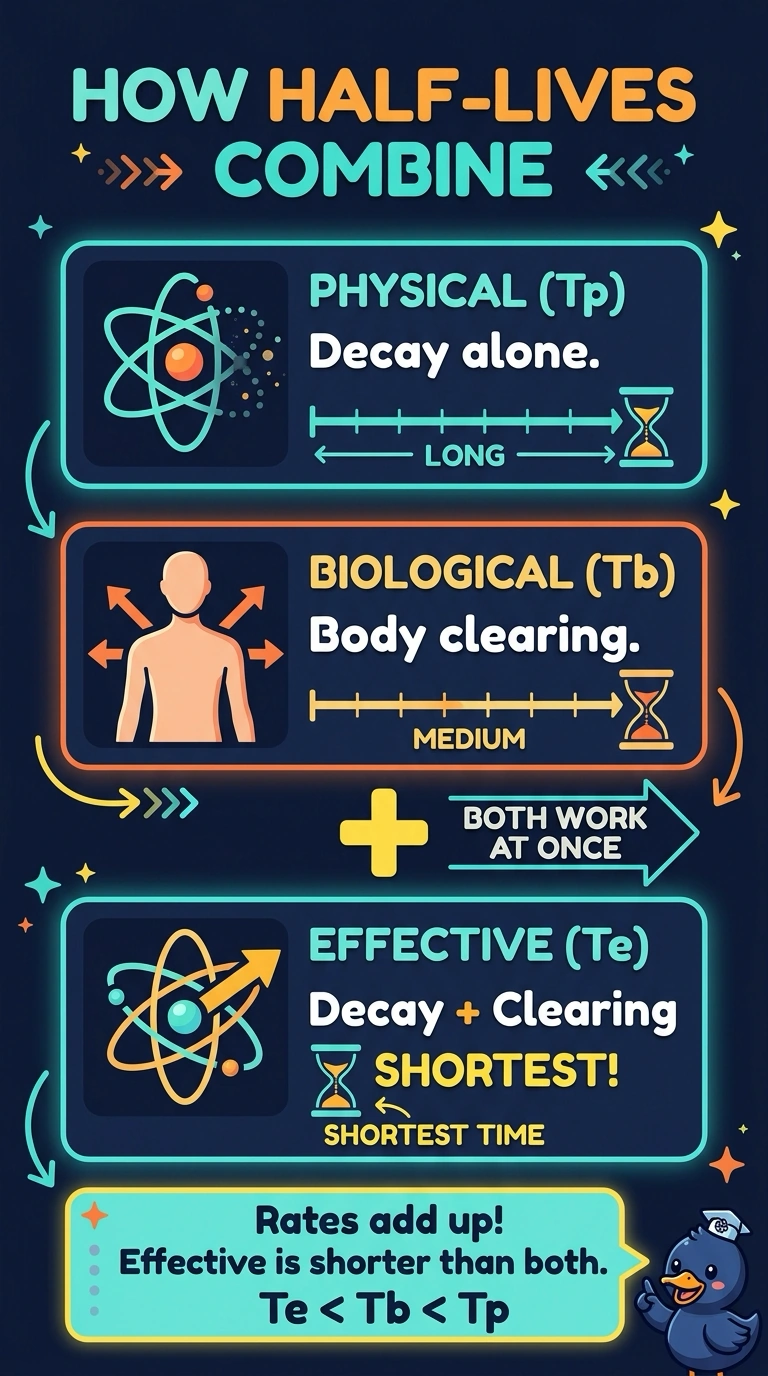
Your patient clears this tracer fast, so the body and decay are working together and activity disappears faster than either one could manage alone. That places the effective half-life below both the biological and the physical values, never between them. Averaging the two numbers is the classic slip — it's the addition of rates that matters, like two drains emptying one tub.
Full Explanation
Effective half-life is the combined result of physical decay and biological elimination, and because removal rates add rather than times, the effective value is always shorter than either the physical or the biological half-life alone. With renal clearance fast enough that the biological half-life is only a fraction of the physical one, the patient loses activity on both tracks at once, so the tracer leaves sooner than decay alone would predict. Treating the effective value as equal to the physical half-life ignores biological elimination entirely and would overestimate how long the patient carries the activity. Treating it as an average of the two half-lives fails because rates, not durations, are what combine, so the result must fall below both values rather than between them. Saying the effective value equals the biological half-life ignores that decay keeps removing atoms even after the body has finished with them. Exam caveat: biological half-life varies with hydration, kidney function, and the chemical form of the tracer, so it is an estimate rather than a fixed constant. Practical check: before quoting a residence time to a patient or a physician, confirm which half-life the question or protocol is actually asking about.