
A 68-year-old with heart failure and suspected cardiac amyloidosis shows clear myocardial tracer uptake on Tc-99m PYP imaging, and SPECT confirms that the uptake sits in the myocardium rather than in the blood pool at one hour. The cardiology team wants a noninvasive confirmation of the amyloid type before therapy starts. Which evaluation must be completed before the study is attributed to ATTR?
Select an answer to reveal the explanation.
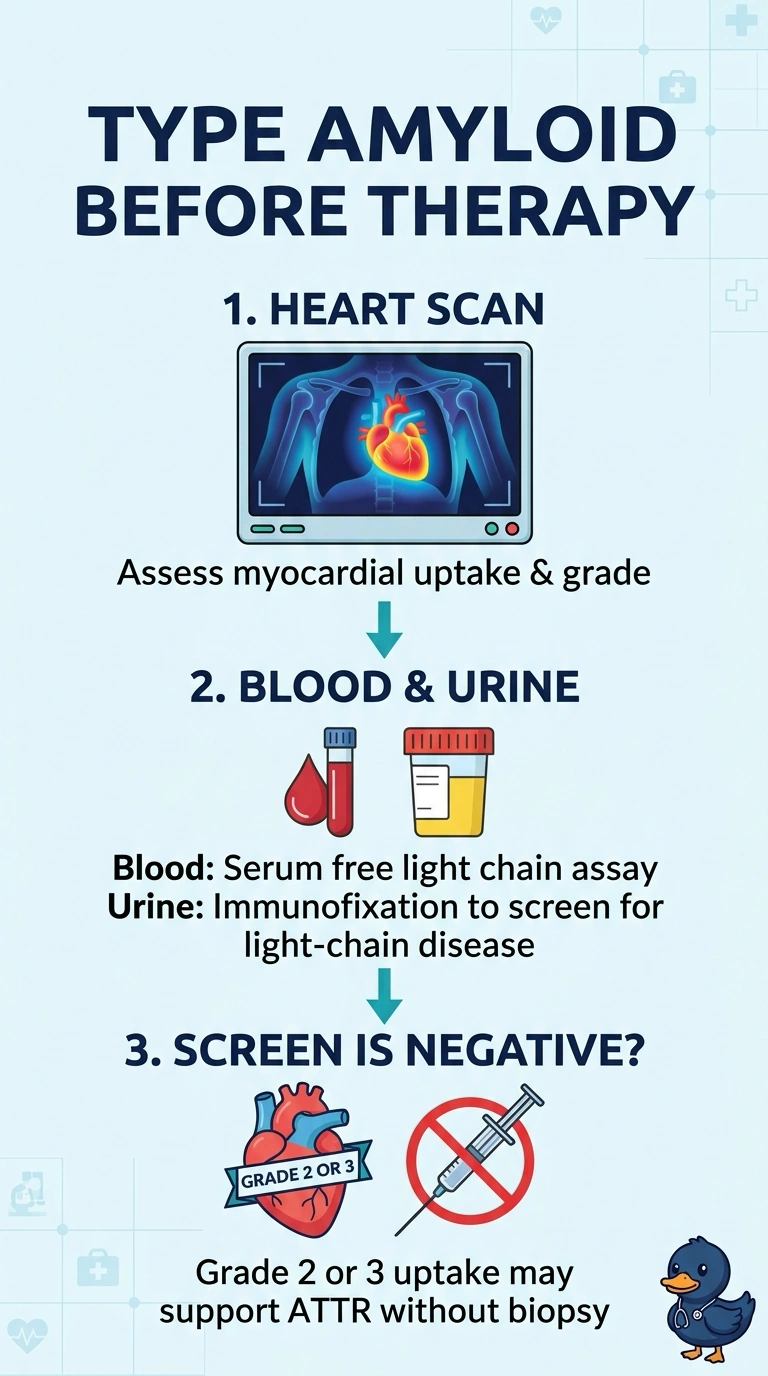
Short Explanation
Before you label the uptake ATTR, you’ve got to screen for light-chain disease with serum free light chains and serum and urine immunofixation. PYP is like a location pin—it shows amyloid is in the heart, not what type it is; if your screen is negative and the scan meets nonbiopsy criteria, you can diagnose ATTR without tissue.
Full Explanation
Myocardial uptake on Tc-99m PYP with SPECT separation from blood pool does not by itself establish the amyloid type. Before making a nonbiopsy ATTR diagnosis, exclude a monoclonal protein with serum free light chain assay and serum and urine immunofixation. A negative screen together with grade 2 or 3 myocardial uptake on bone scintigraphy supports a nonbiopsy diagnosis of ATTR cardiac amyloidosis in the appropriate clinical setting; a monoclonal protein or discordant findings require further evaluation, often including tissue biopsy with amyloid typing. TTR gene sequencing identifies inherited TTR variants after ATTR has been diagnosed, but it does not exclude a monoclonal protein. Delayed imaging can help clarify blood-pool activity, but it does not establish the amyloid type. Exam caveat: uptake grade and SPECT localization matter; myocardial uptake alone is not sufficient for a nonbiopsy ATTR diagnosis. Practical check: confirm that serum free light chains and both serum and urine immunofixation results are available before assigning an amyloid type.