
A patient with stable angina is scheduled for myocardial perfusion imaging today. Severe knee osteoarthritis rules out walking on a treadmill, and the chart documents physician-diagnosed asthma with active wheezing today. Resting rhythm is sinus with normal blood pressure. Which stress agent best fits this perfusion study?
Select an answer to reveal the explanation.
Short Explanation
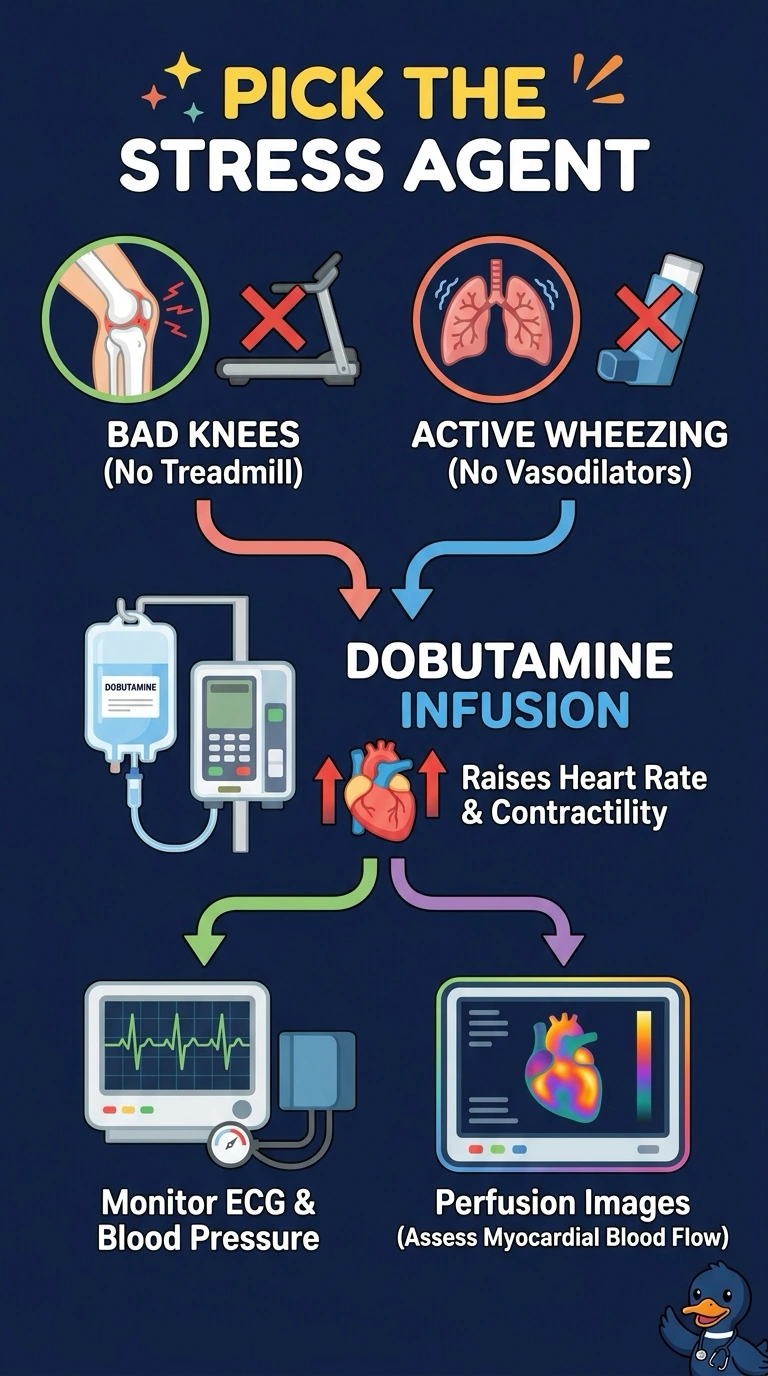
You're matching the stress method to two limits in the chart. Dobutamine raises the heart's rate and contractility without relying on exercise or adenosine-receptor vasodilation, making it the best fit while the patient is actively wheezing.
Full Explanation
Dobutamine is an inotropic agent that raises heart rate and contractility, creating a supply-and-demand mismatch that permits perfusion imaging while the patient stays off the treadmill. Adenosine and regadenoson can cause bronchoconstriction; active wheezing makes vasodilator stress a poor choice, even though regadenoson is more selective for the A2A receptor and is not categorically contraindicated in every patient with asthma. Treadmill walking is ruled out by the mobility limit. Dobutamine responses vary, and beta-blockers or an arrhythmia history can blunt or complicate the protocol, so confirm the current medication list and relevant history before starting. Verify the asthma history, baseline ECG, and blood pressure, then monitor rhythm and pressure during the infusion and recovery.