
Four radiation events get confused in practice: a fast electron slowing in a shield, an excited nucleus handing energy to an orbital electron, an inner-shell vacancy ejecting an electron, and a photon beam crossing matter. Each has its own mechanism, energy pattern, and range. Which statement correctly describes the physics of attenuation, bremsstrahlung, internal conversion, or Auger emission?
Select an answer to reveal the explanation.
Short Explanation
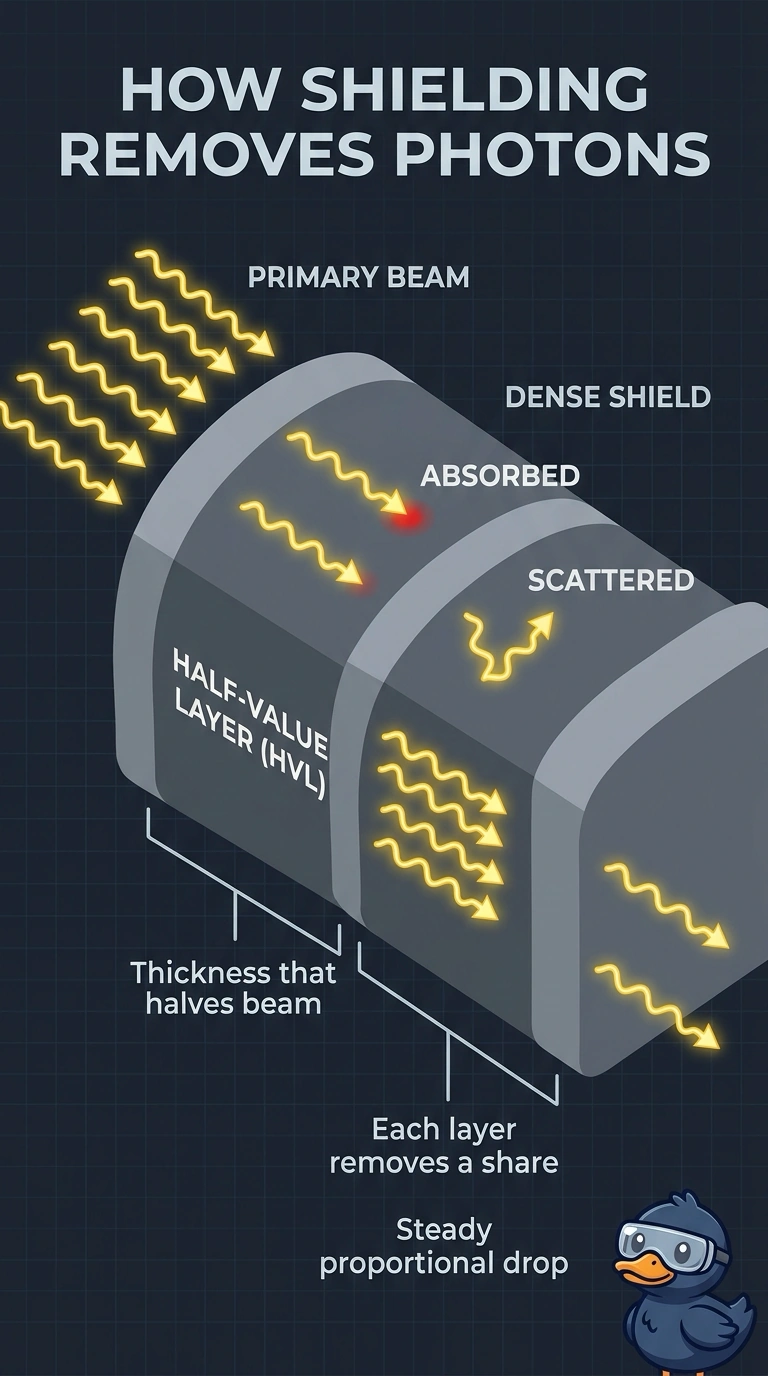
You can think of attenuation as the primary beam losing photons as it crosses matter, either through absorption or scattering. Because each layer removes a share of what remains, the intensity drops exponentially, rather than in a straight line. Picture a crowd thinning as people peel off at each gate along a corridor.
Full Explanation
Attenuation describes the loss of photons from the primary, unscattered beam through absorption or scattering, so its intensity commonly decreases exponentially with material thickness. Scattering removes photons from the primary beam just as absorption does, even though some scattered photons may still reach a detector; that is why defining attenuation as absorption alone is too narrow. Bremsstrahlung from a slowing electron does form a continuous photon spectrum, but its peak is not near the electron’s initial kinetic energy: the spectrum is generally weighted toward lower photon energies, and its upper endpoint cannot exceed the electron’s kinetic energy in the usual single-event description. Auger emission does produce discrete-energy electrons during shell relaxation, but these low-energy electrons usually deposit their energy over very short distances, often nanometers to micrometers in tissue, rather than millimeters. Exam caveat: the exponential attenuation law assumes a defined, approximately uniform beam and geometry; with a broad beam, scattered radiation reaching the detector can make measured intensity depart from a simple exponential decrease. Practical check: measure the narrow-beam primary signal at successive material thicknesses and check whether transmission follows an exponential trend.