
Morning PET/CT quality control passes on this unit: energy peaking, uniformity flood, and the CT air-water calibration are all within tolerance. A repeat study of a stable patient still shows SUVs consistently higher than baseline despite identical injected activity, uptake time, and decay correction. Which calibration check should the technologist run next to explain the shift?
Select an answer to reveal the explanation.
Short Explanation
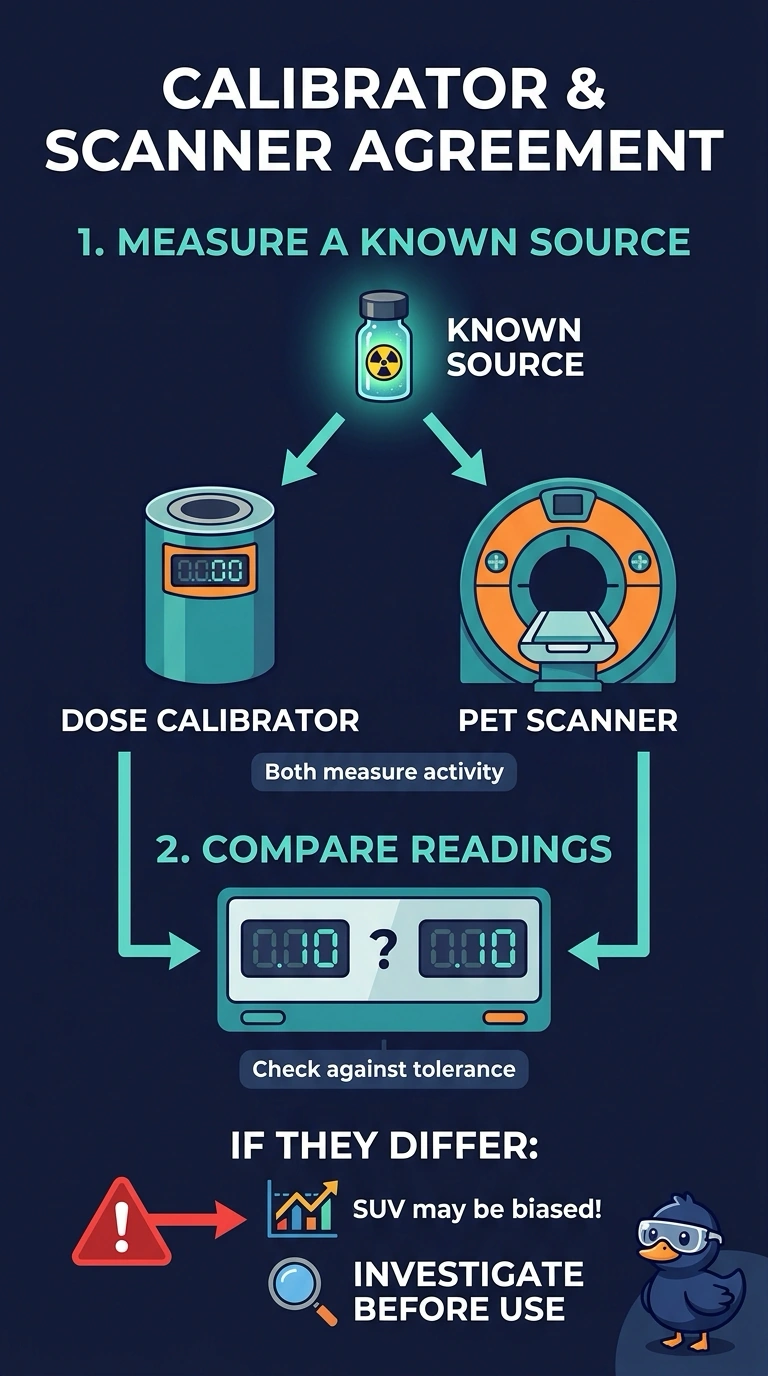
Since your daily checks pass, compare the dose calibrator and PET scanner readings for the same known source—it’s like checking two scales against the same weight. Cross-calibration can reveal a mismatch that makes SUVs read higher.
Full Explanation
SUV calculation relies on activity measured at injection, so the dose calibrator and PET scanner readings must agree when both measure a known source using the prescribed cross-calibration procedure. A disagreement can bias SUVs upward even when energy peaking, uniformity, CT air-water calibration, injected activity, uptake time, and decay correction appear satisfactory. Re-peaking the PET energy window on the 511-keV photopeak with the daily flood source checks energy alignment, but it does not test agreement between the activity measurement devices; the daily energy and uniformity checks have already passed. Recalibrating CT Hounsfield values with air and water addresses CT numbers and the attenuation map, not a mismatch in measured activity; the stated CT calibration is also within tolerance. Auditing injection and uptake time records can catch discrepancies in those entries, but they are specified to match baseline, so this audit does not explain the remaining shift. An exam caveat is that cross-calibration must follow the site’s prescribed source, geometry, timing, and tolerance rather than relying on an informal comparison. Practically, measure a known source with both systems under the required conditions, compare the readings, and investigate any out-of-tolerance difference before relying on quantitative SUVs.