
A patient recovering from a stroke is non-weight-bearing and has limited use of both arms, so two staff members must move the patient from the bed onto the nuclear medicine table for a bone scan. The bed and the table sit at fixed, unequal heights, and the department has a draw sheet and a slide board while its mechanical lift is in use on another unit. Which action best protects the patient and the staff?
Select an answer to reveal the explanation.
Short Explanation
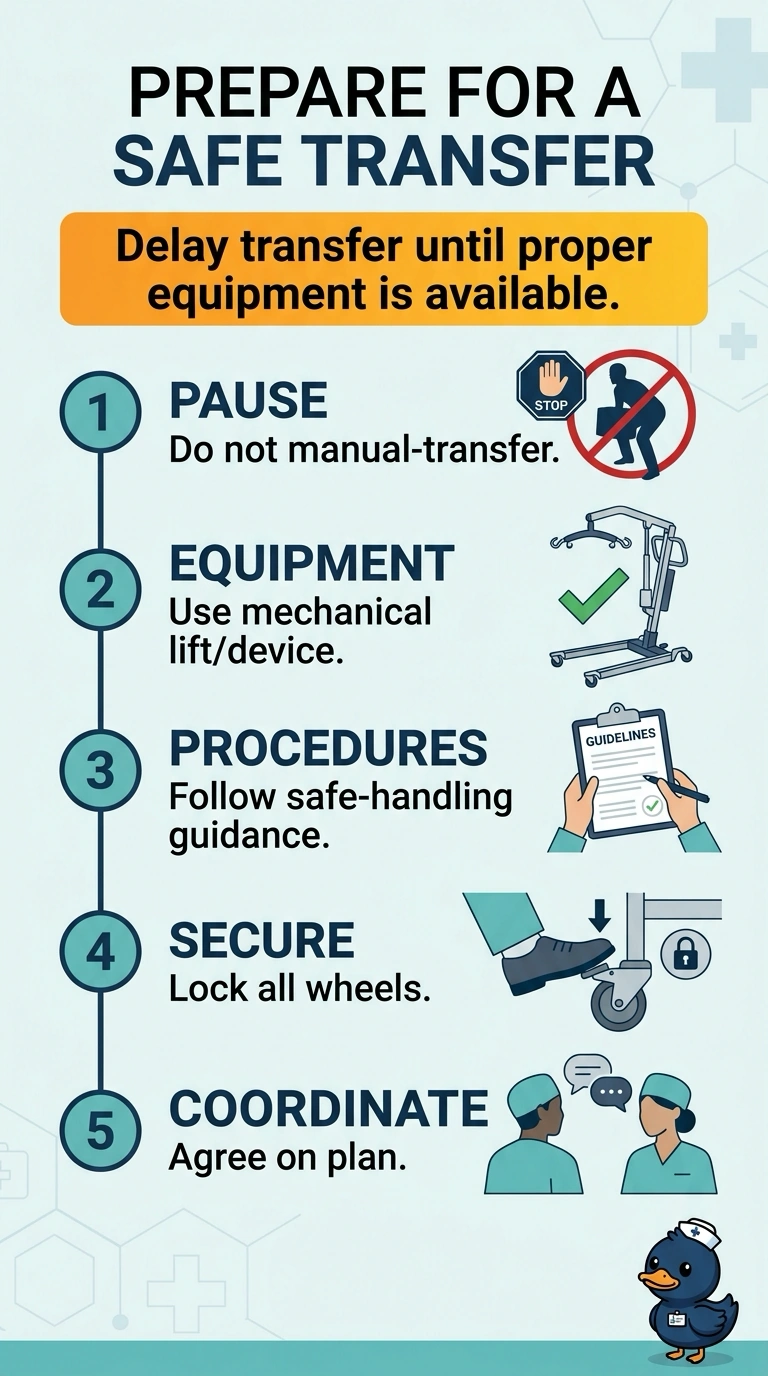
You shouldn’t try to bridge the height difference with a draw sheet or slide board when the patient can’t bear weight or use their arms effectively. Wait for a mechanical lift or other suitable equipment—it’s the right tool for a safe transfer, like using a ramp instead of trying to lift a heavy load uphill.
Full Explanation
Delaying the transfer until suitable equipment is available is safest because the patient cannot bear weight, has limited use of both arms, and must be moved between surfaces at fixed, unequal heights. A mechanical lift or another appropriate transfer device can support the patient without relying on active participation or a hazardous manual lift. A draw-sheet lateral transfer is commonly used for patients who cannot stand, but it requires compatible, nearly level surfaces; the fixed height difference makes sliding the patient across the gap unsafe and increases shear and staff injury risk. A slide board can facilitate lateral transfers when the patient can participate and the surfaces are aligned, but it does not make this bed-to-table transfer safe across unequal heights; limited arm use also restricts the patient's ability to assist. A two-person manual lateral lift avoids asking the patient to bear weight, but it places substantial physical demands on staff and does not provide the support or load reduction required for a safe transfer. Exam caveat: a familiar transfer technique is not automatically appropriate when the patient's functional status or equipment setup differs from the technique's usual conditions. Practical check: before proceeding, confirm that the selected device is available, compatible with both surfaces, and can maintain safe alignment throughout the transfer.