
The daily constancy check on the dose calibrator reads about 10 percent low for the sealed reference source on every radionuclide setting, with the battery check passing and background normal. Repeating the measurement with the source centered in the well gives the same low result. Which dose calibrator QC test should be performed next to help identify the cause?
Select an answer to reveal the explanation.
Short Explanation
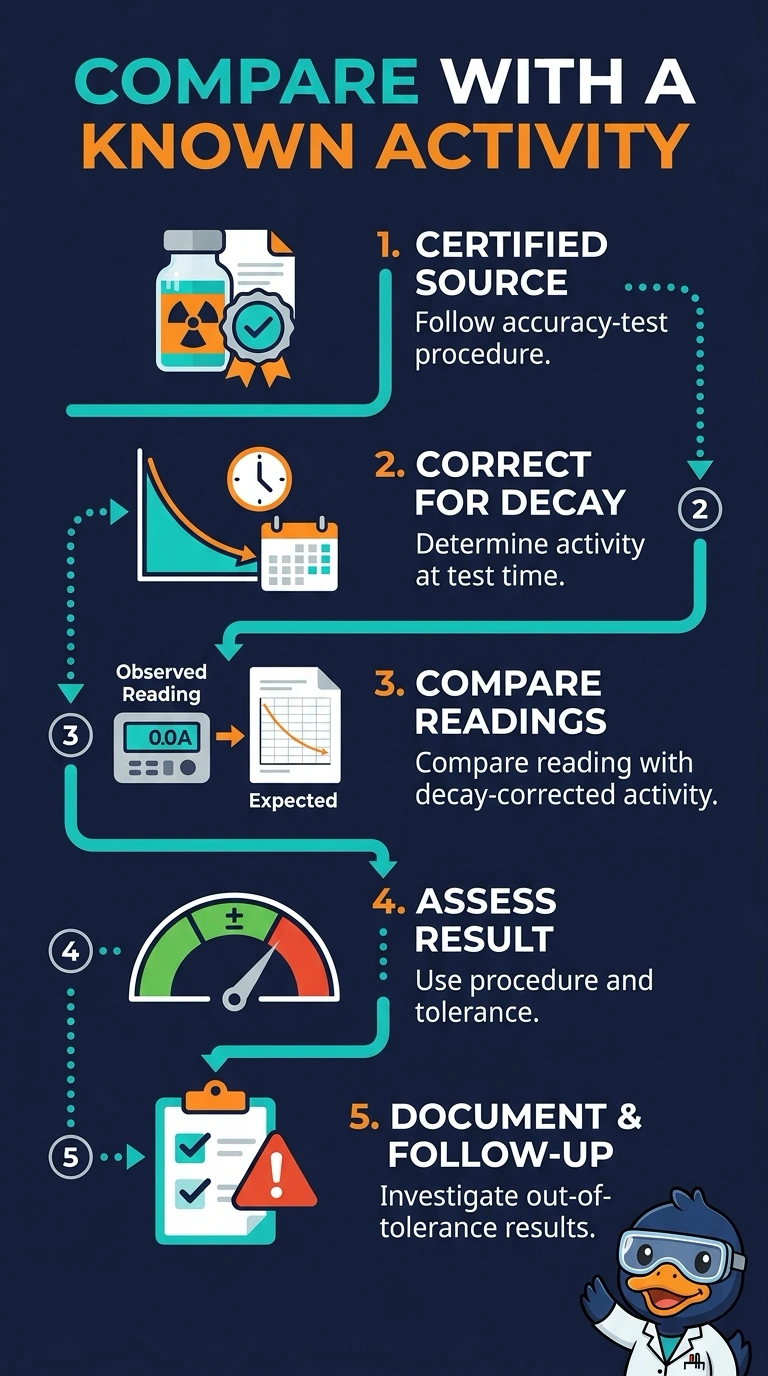
You can perform an accuracy test with a certified source of known activity, then compare the reading with its decay-corrected activity. It’s like checking a scale against a known weight: you’ll see whether the low result also appears in an independent measurement.
Full Explanation
An accuracy test is the best next step because it compares the calibrator’s indicated activity with the decay-corrected activity of a certified source. A similar low result on every radionuclide setting suggests a systematic bias, and the battery and background checks have not identified an explanation; the accuracy test directly establishes whether the instrument’s readings are correct. A linearity test is a standard QC test, but it assesses how response changes across a range of activities. A calibrator can be linear while remaining uniformly low, so that test would not establish the absolute error described here. A geometry test is also a standard approach for assessing effects of container type, volume, or source configuration, but the reported low result is not tied to a change in geometry; it would not directly check the calibrator against a known activity. Repeating measurements to assess precision can show whether readings are consistent, but reproducible readings can still be systematically inaccurate. Exam caveat: constancy, accuracy, linearity, geometry, and precision assess different performance properties, so a passing result on one does not substitute for another. Practical check: verify the certified source’s identity, reference activity and date, decay correction, selected setting, and prescribed measurement geometry before interpreting the accuracy result.