
In the hot lab, a technologist draws three patient doses from a single eluted vial for a busy afternoon list, and each syringe is headed to a different patient. Lab policy requires sterile doses with no cross-contamination. Which preparation sequence follows correct aseptic technique for this task?
Select an answer to reveal the explanation.
Short Explanation
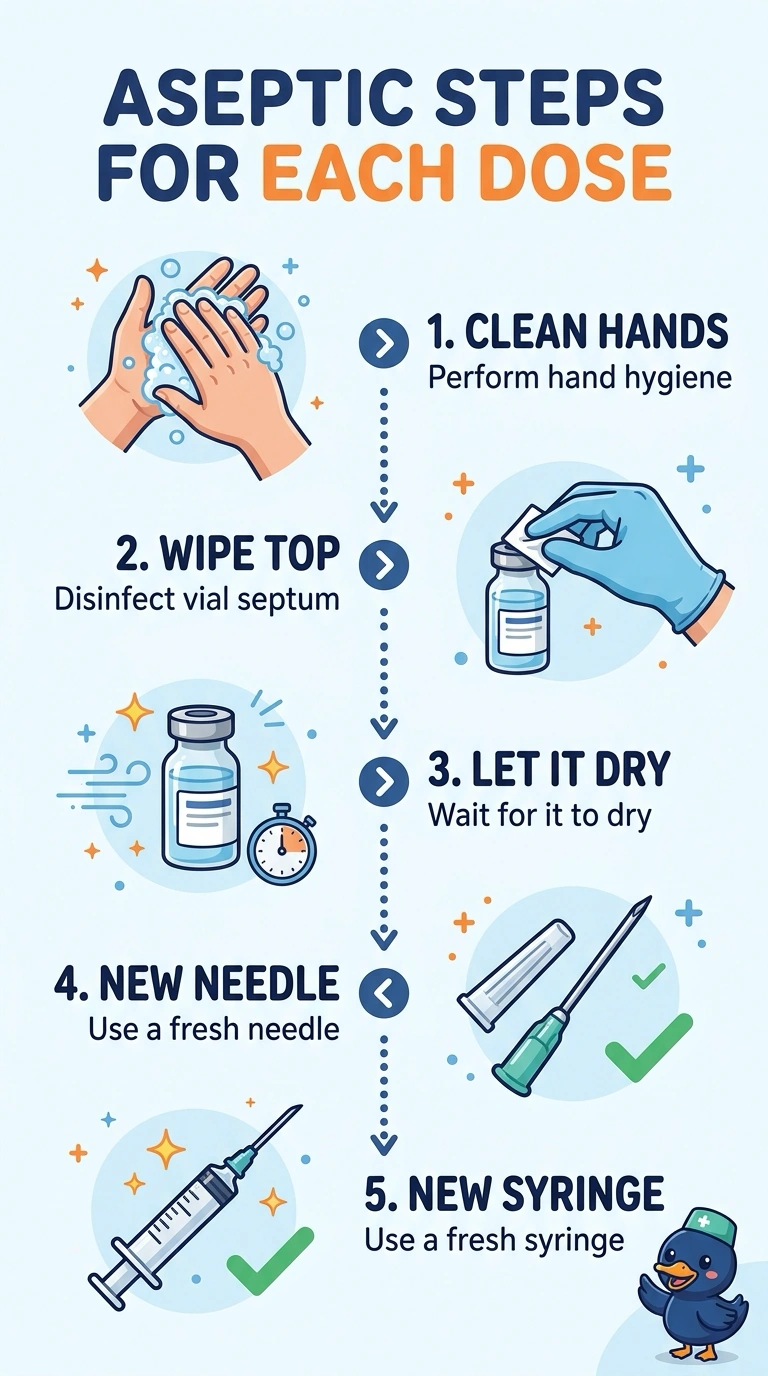
You’ll start with hand hygiene, disinfect the septum and let it dry before each entry, then use a fresh sterile needle and syringe for every dose. That aseptic technique helps keep contamination from traveling between patients through the vial or equipment.
Full Explanation
Aseptic dose preparation depends on applying the required controls in sequence. Perform hand hygiene before beginning, disinfect the septum and allow the product’s required contact time, then let it dry before each vial entry; this reduces contamination where the needle penetrates and helps prevent wet disinfectant or residue from being carried into the vial. Use a fresh sterile needle and syringe for every patient dose to prevent carryover between doses. Keeping gloves worn during an earlier task does not replace hand hygiene, so that approach lacks an essential control. Disinfecting the septum but entering it at once fails to let it dry, which can carry disinfectant or residue into the vial. Drawing all doses with one sterile needle while changing syringes reuses the needle, leaving a shared contamination path between patient doses. The correct sequence combines hand hygiene, septum disinfection and drying before each entry, and a new sterile needle and syringe for each dose. An exam caveat is that the required disinfectant contact time depends on the product; follow its instructions rather than assuming a fixed interval. As a practical check, confirm the septum is dry and a fresh sterile needle-and-syringe set is ready before every entry.