
A radiopharmacy director is comparing three supply routes before signing a new contract: a nuclear reactor, a medical cyclotron, and a generator column. The director wants each route matched to the physical process that actually creates the nuclide. Which statement accurately compares all three production routes?
Select an answer to reveal the explanation.
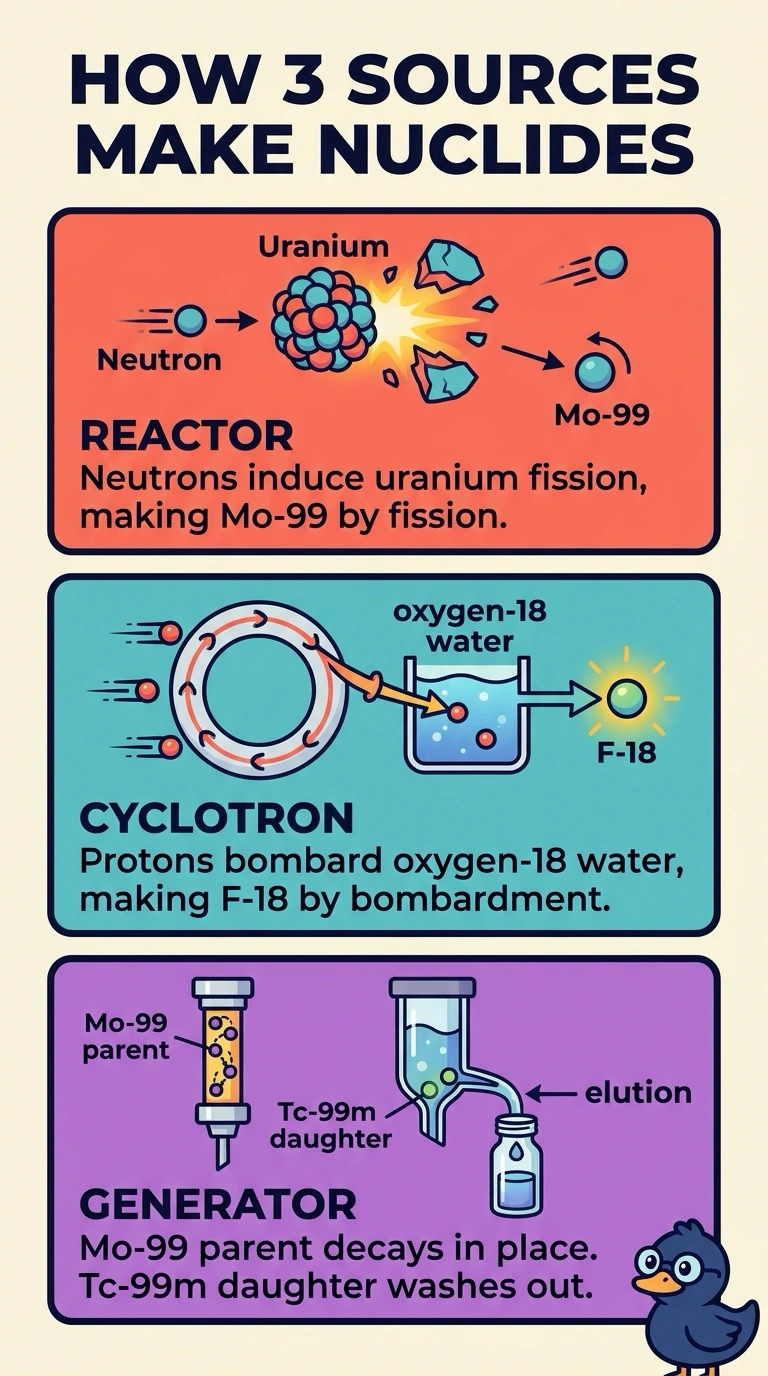
Short Explanation
You’ve got three different production routes: a reactor makes Mo-99 through neutron-induced uranium fission, while a cyclotron makes F-18 by bombarding oxygen-18 water with protons. A generator is like a parent-to-child handoff: decay turns Mo-99 into Tc-99m, and elution separates the Tc-99m—it doesn’t create its activity.
Full Explanation
Reactor production can rely on neutron-induced fission of uranium, which produces molybdenum-99, the parent of technetium generators. A medical cyclotron accelerates charged particles; a standard fluorine-18 route is proton bombardment of oxygen-18-enriched water, producing a positron emitter. A generator works by decay ingrowth: molybdenum-99 on the column decays into technetium-99m, and the daughter is eluted with saline while the parent remains on the column. Attributing reactor production to proton bombardment confuses a cyclotron process with a neutron process. Assigning neutron irradiation to the cyclotron is incorrect because a medical cyclotron accelerates charged particles, not neutrons. Describing generator production as chemical separation without decay omits the radioactive decay that creates technetium-99m. Elution is a chemical separation step; the daughter activity comes from radioactive decay.