
A patient with severe asthma after a recent wheezy flare needs a rest and stress myocardial perfusion study, and a painful hip rules out treadmill exercise. The department runs a one-day Tc-99m sestamibi protocol in which stress activity exceeds rest activity. Which combination of radiopharmaceutical, activity pattern and stress agent best fits this patient?
Select an answer to reveal the explanation.
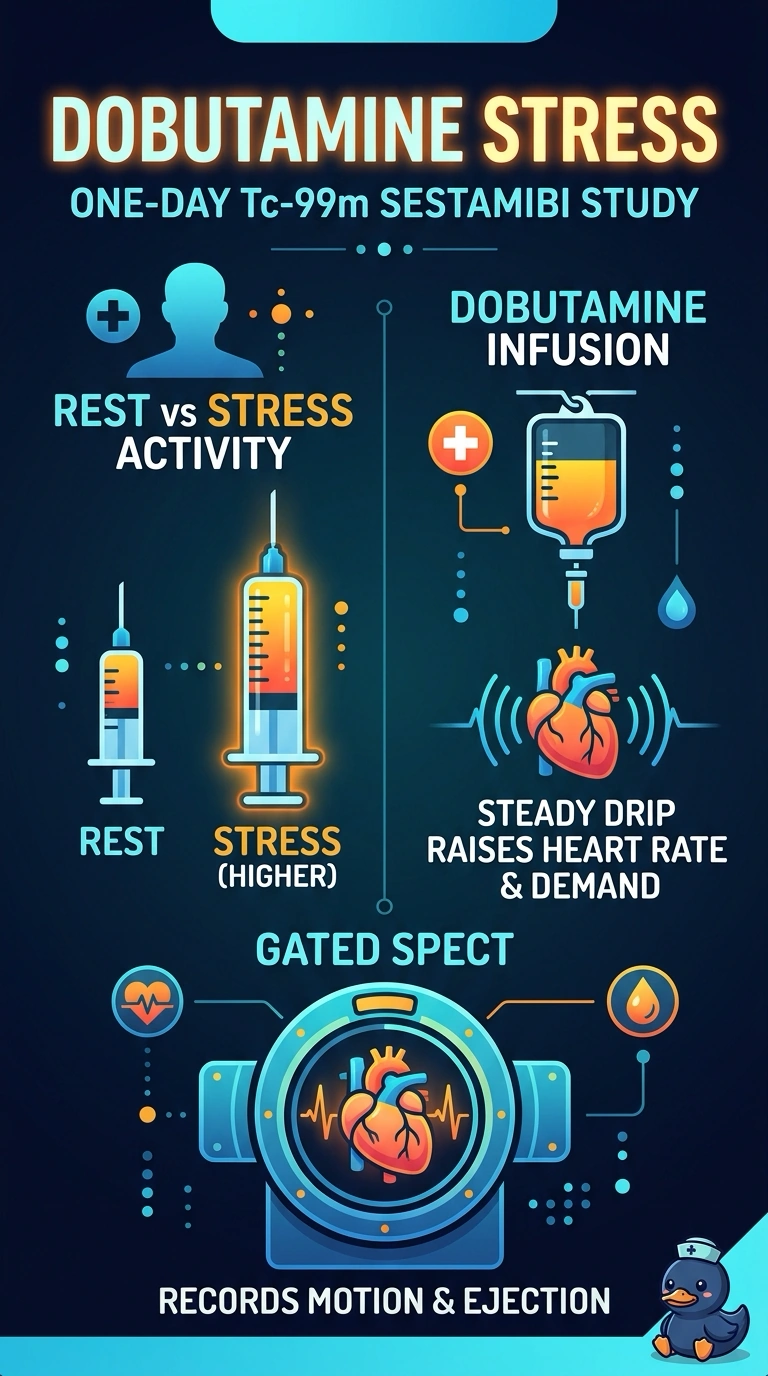
Short Explanation
Dobutamine pushes heart rate and oxygen demand up so coronary flow increases, and it does that without provoking your patient's airway. Vasodilator agents can pose a bronchospasm risk in a patient with recent wheezing, and the painful hip takes treadmill exercise out of the picture. Keeping stress activity above rest activity is what gives the stress study its edge, so the higher activity can provide more counts when you image.
Full Explanation
Dobutamine stress works by stimulating beta-1 adrenergic receptors, which raises heart rate, contractility and myocardial oxygen demand; the coronary circulation responds by increasing flow, so tracer distribution reflects regional perfusion reserve without requiring the patient to walk. That makes dobutamine a suitable agent when bronchospasm risk makes vasodilator drugs unattractive and when a painful joint prevents symptom-limited exercise. In a one-day technetium-99m sestamibi protocol the stress injection carries more activity than the rest injection, so, all else being equal, higher stress activity generally provides more stress-image counts. Choosing a vasodilator agent in a patient with severe asthma and recent wheezing raises concern for bronchoconstriction, while choosing treadmill exercise ignores the stated mobility limit. Substituting equal rest and stress activities keeps the tracer and the drug correct but does not follow the stated protocol. Exam caveat: airway status drives the decision, because vasodilator use in patients with asthma requires clinical judgment and appropriate precautions. Practical check: before the stress phase, confirm exercise capacity, airway status and the activity scheduled for each injection.