
A first-pass cardiac study is ordered for an adult patient, and the cardiologist wants to compare the same injection data at two different frame rates, with the choice made after the study ends. No detected events should be discarded during acquisition. Which acquisition mode keeps the data usable at frame rates chosen later?
Select an answer to reveal the explanation.
Short Explanation
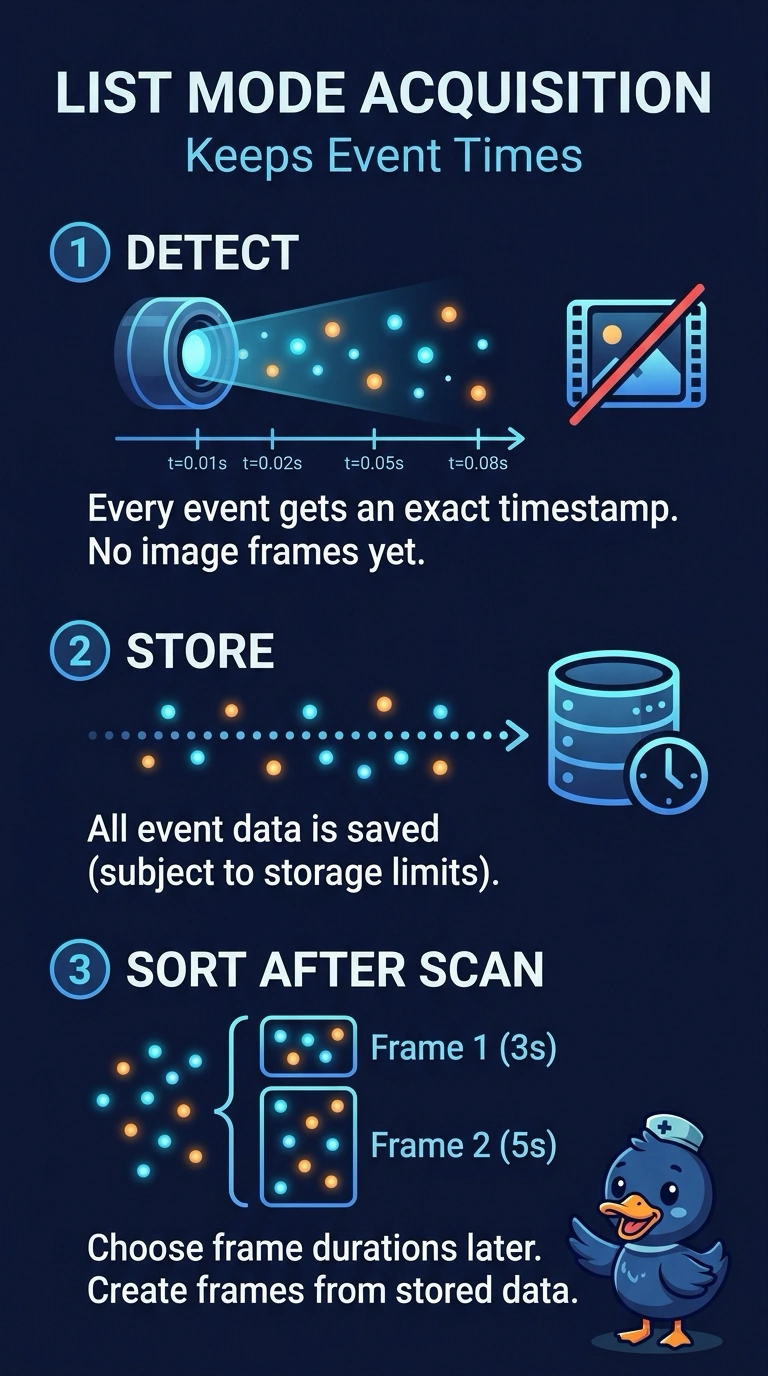
With list mode, you keep every detected event tagged with its own time—like saving timestamped receipts before sorting them later—so you can group the same data into frames at different rates after the study. Unlike conventional dynamic, static, or ECG-gated acquisition, you don’t have to lock in those settings during collection.
Full Explanation
List mode stores individual recorded events with timing information rather than assigning them to image frames during acquisition. The data can then be sorted into different frame durations after acquisition, within the temporal resolution and information retained by the system. This makes list mode appropriate when the same first-pass data must be reviewed at more than one frame rate. In conventional dynamic acquisition, events are assigned to frames using the frame timing selected for the acquisition; already formed frames may sometimes be combined into longer intervals, but they cannot recover finer timing that was not retained. Conventional ECG-gated acquisition groups events by cardiac phase, and conventional static acquisition produces an image without the temporal detail needed for retrospective framing. List-mode acquisition requires adequate storage and software that supports retrospective sorting; recorded information is also subject to the system's acquisition and storage limits.