
A repeat gated blood-pool study reports an ejection fraction of 26% for a patient whose study three years earlier read 51%. On review, the fixed ventricle region includes part of the left atrium and adjacent lung, and the time-activity curve is noisy around an irregular end-systolic trough. Which correction should be made before this ejection fraction is released?
Select an answer to reveal the explanation.
Short Explanation
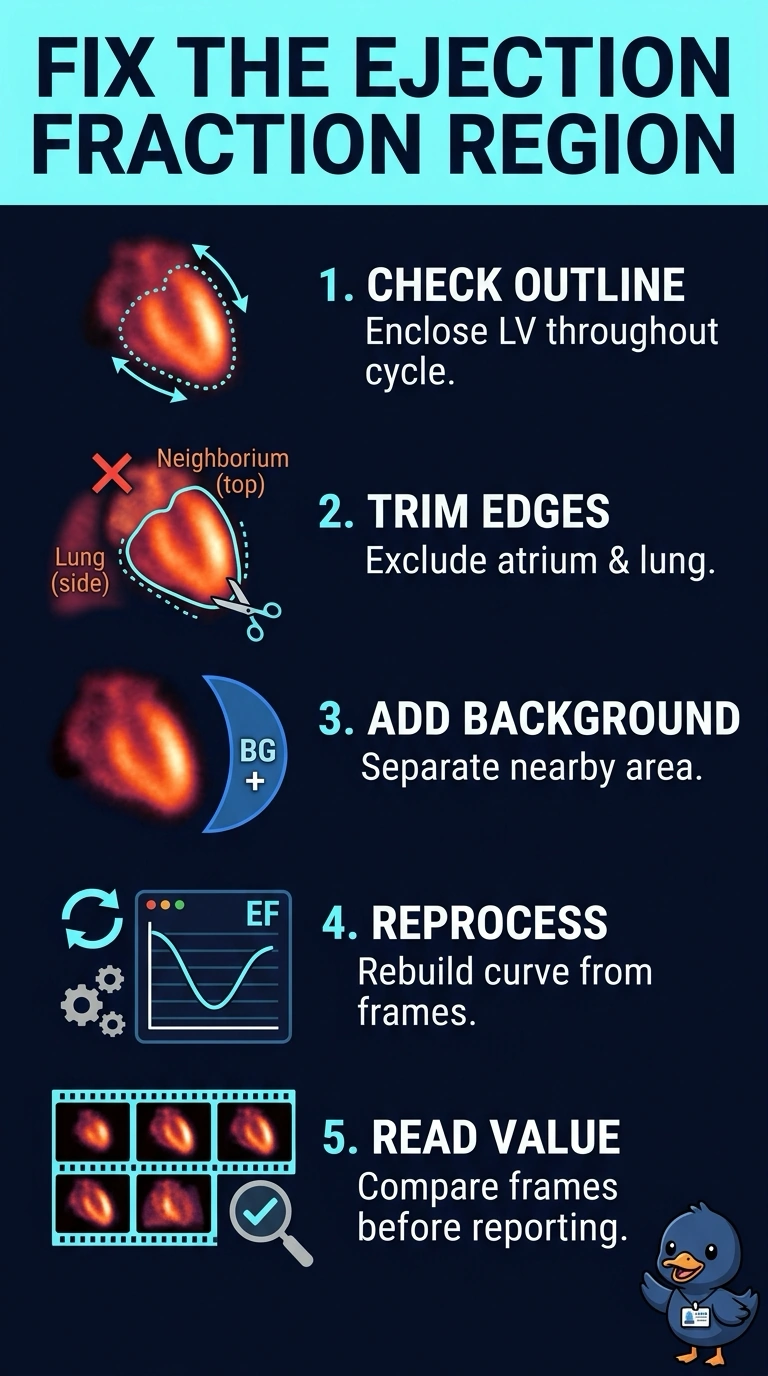
Your region of interest should follow the left ventricle throughout the cycle without including the atrium or lung. Add a separate background region and reprocess; more counts cannot correct a misplaced boundary.
Full Explanation
The gated blood-pool study builds its time-activity curve from counts in the ventricular region across cardiac frames, so appropriate region placement and background correction matter. Including part of the left atrium and adjacent lung adds counts that do not represent ventricular activity and can affect the calculated ejection fraction. Redraw the ventricular region to enclose the left ventricle throughout the cycle without including the atrium or lung, define a separate background region, and reprocess the curve. Applying standard background correction and smoothing the full curve while retaining the original fixed outline does not correct the boundary error; smoothing also cannot make nonventricular counts representative of ventricular activity. Adding cardiac cycles may reduce counting statistical noise, and a longer acquisition may raise counting statistics, but neither changes the misplaced region or fixes its effect on the ejection fraction. An irregular end-systolic trough is not, by itself, proof of a region-boundary problem, so review the gating and curve before accepting the result. As a practical check, confirm that the ventricular outline follows the left ventricle across the cycle, excludes the atrium and lung, and has a separate background region before releasing the recalculated value.