
A hospital PET service plans a new tracer that decays by positron emission, has a half-life near two hours, and has a parent nuclide that would decay away before it could be stored. The tracer must be produced on site for a same-morning injection. Which production route best fits this tracer?
Select an answer to reveal the explanation.
Short Explanation
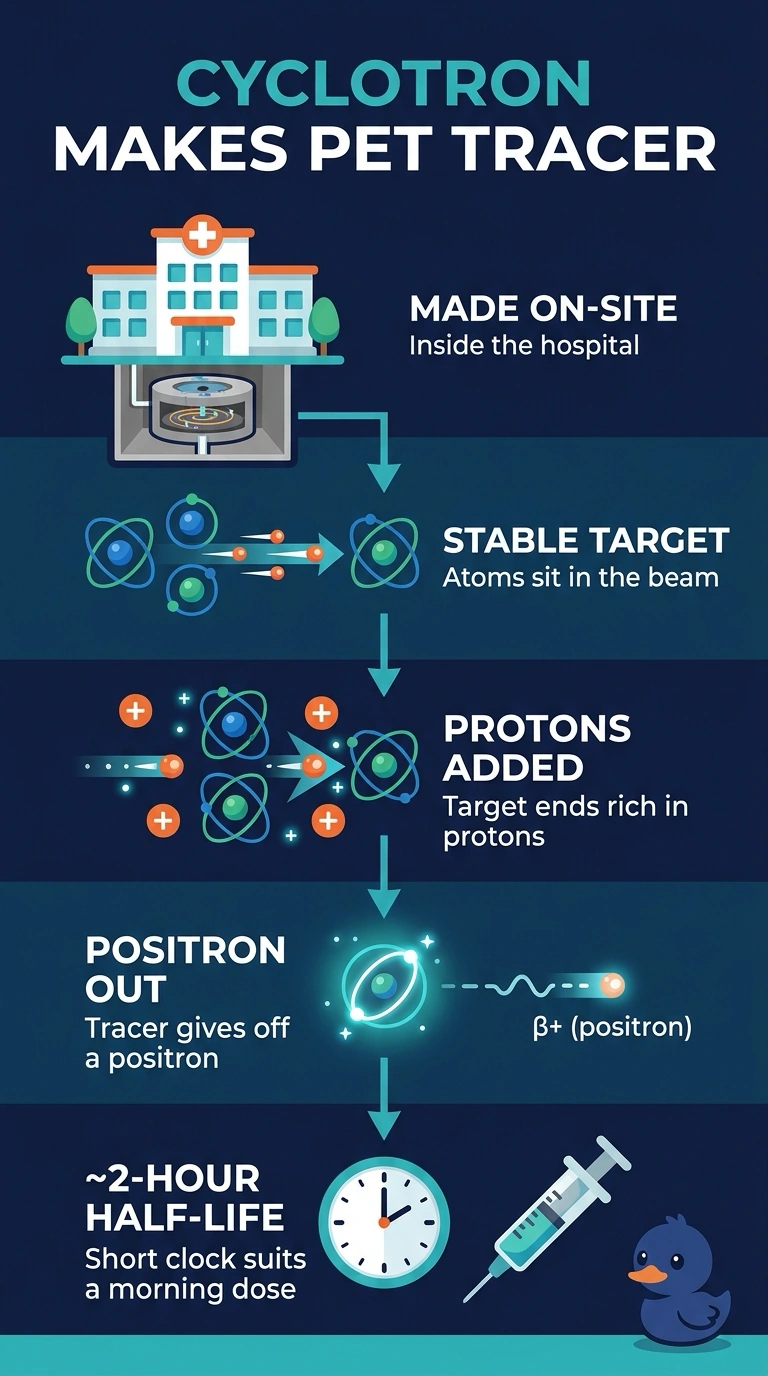
Cyclotron beams add protons to a stable target, which leaves your product proton-rich and ready to emit a positron. Reactor neutrons head the other way, and a generator needs a long-lived parent that this tracer doesn't have. With a two-hour clock ticking, an on-site cyclotron is the only route that keeps up.
Full Explanation
The cyclotron route is the best fit because charged-particle irradiation of a stable target can produce the proton-rich radionuclide directly at the hospital. On-site production matters for a tracer with a roughly two-hour half-life: it avoids transport time, while the stated lack of a storable parent rules out relying on a generator. Neutron activation of stable copper-63 is a real reactor production route for positron-emitting copper-64, but copper-64’s half-life is about 12.7 hours, not near two hours. The generator approach is also established in nuclear medicine, but it depends on a parent that remains available long enough to be stored and repeatedly eluted; that conflicts with the stated parent-decay constraint. Regional cyclotron production could make a suitable short-lived positron emitter, but delivery from another site fails the explicit requirement that the tracer be produced on site for same-morning use. Exam caveat: positron emission alone does not identify the production method; the isotope’s half-life, parent-daughter properties, target reaction, and local production capability all matter. Practical check: confirm the intended radionuclide’s identity and half-life, the validated target reaction and expected yield, and that the hospital’s cyclotron and synthesis schedule can support the injection time.