
A 63-year-old patient arrives for a myocardial perfusion PET study after the radiopharmacy delivery runs late, so acquisition timing may need adjustment afterward. Body habitus raises image noise, and the reading cardiologist wants respiratory motion controlled. Which PET imaging setup satisfies all three needs for this exam?
Select an answer to reveal the explanation.
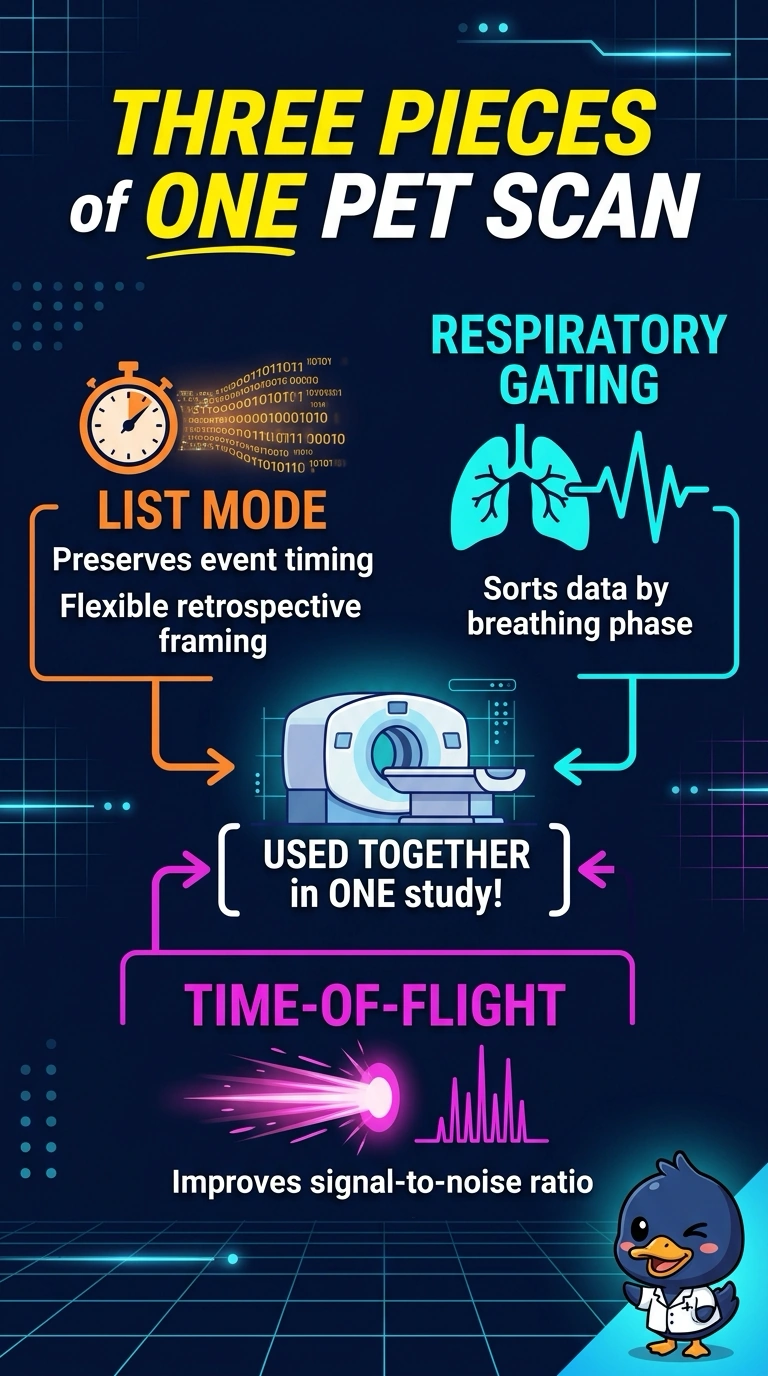
Short Explanation
With list mode, you save the full event timeline like a recording you can rewind, so you can choose the right frames later—just make sure you document the injection time to select the intended uptake window. Respiratory gating sorts counts by breathing phase, while time-of-flight can reduce noise when your patient’s body habitus makes images noisier.
Full Explanation
List mode stores detected coincidences with timing information rather than assigning them only to fixed frames during acquisition. This allows frame boundaries to be selected retrospectively within the acquired data; it does not recover data from before acquisition began, or determine an undocumented injection time. Respiratory gating sorts list-mode events into breathing bins to reduce motion-related blurring. Time-of-flight uses differences in coincidence arrival time to improve event localization and can improve signal-to-noise ratio, which is useful when body habitus raises image noise. Frame-mode acquisition assigns counts to predefined frames during acquisition, limiting retrospective changes to frame boundaries. The ungated list-mode acquisition preserves timing information and can use time-of-flight, but does not control respiratory motion. Standard non-time-of-flight OSEM can reconstruct gated list-mode data, but lacks the potential signal-to-noise benefit of time-of-flight. Time-of-flight does not change how attenuation correction is performed. Confirm that the list-mode data and respiratory gating signal are saved.