
A technologist runs SPECT quality control on a uniform phantom after a detector service visit. Reconstructions show a symmetric rotating spot artifact and wavy sinogram traces, while today's flood uniformity, energy peak and resolution checks all meet tolerance. Which camera QC test should be run first to investigate the rotating artifact?
Select an answer to reveal the explanation.
Short Explanation
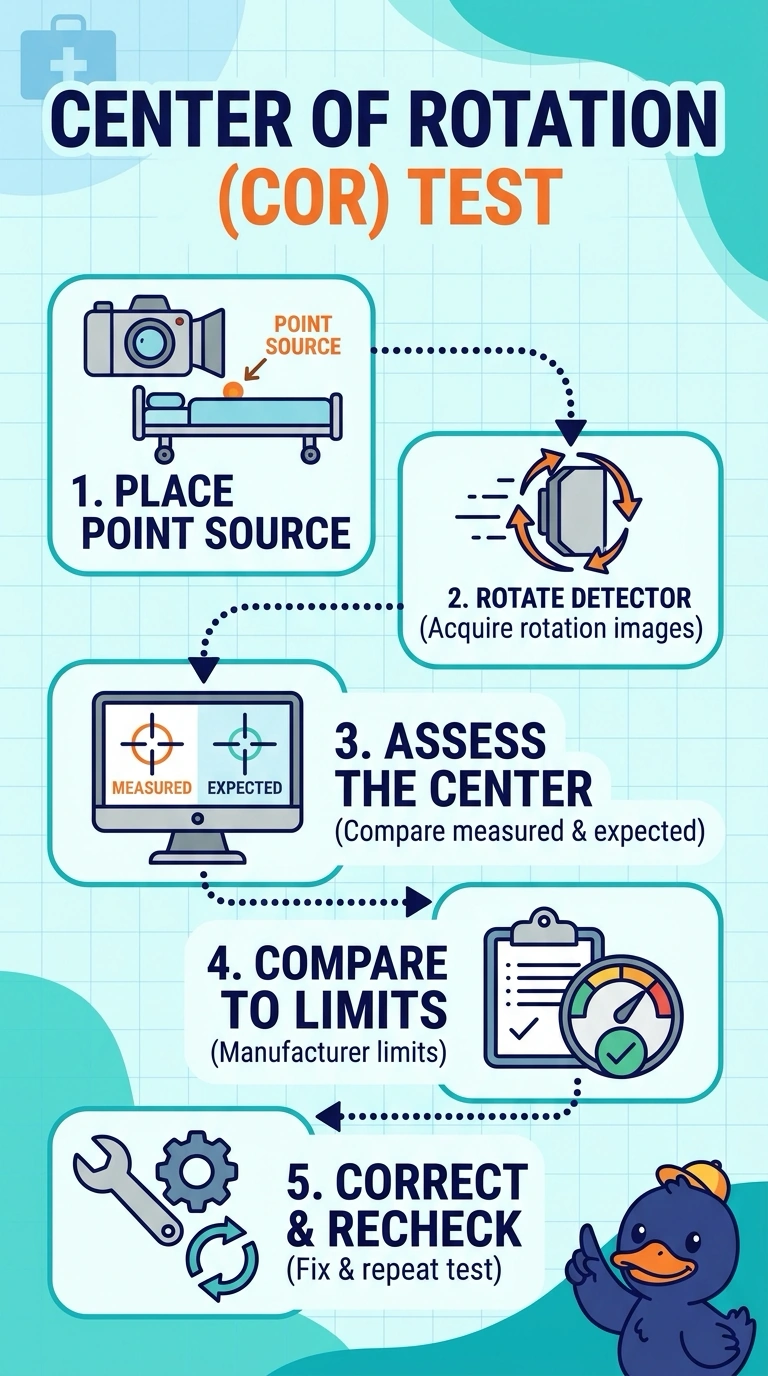
You should first run the center of rotation test with a point source and compare the measured center with the system’s expected center. A mismatch can cause the rotating spot and wavy sinogram—like a wheel that looks steady at rest but wobbles once it turns.
Full Explanation
A center of rotation error occurs when the detector’s actual axis of rotation does not match the axis assumed during reconstruction. This mismatch can produce a rotating artifact in the reconstructed image and wavy or sinusoidal sinogram traces. A point-source center of rotation test measures the offset from the system’s expected center and is therefore the most relevant first test for this pattern, especially after detector service. Repeating the uniformity flood at higher count density is less relevant because today’s flood meets tolerance, and uniformity problems more commonly produce fixed nonuniformities. Rechecking the photopeak position and adjusting the imaging window is also less relevant because the energy peak is within tolerance; it does not directly assess the rotation axis. Repeating resolution and linearity testing with a bar phantom is likewise less relevant when those checks meet tolerance, since those tests assess spatial performance rather than the center of rotation. Exam caveat: passing flood, energy-peak, and resolution checks does not rule out a center of rotation error. For a practical check, follow the camera manufacturer’s point-source procedure and compare the measured center with the expected center using the specified tolerances.