
A patient with unilateral hydronephrosis on ultrasound is sent for a diuretic renogram to separate true obstruction from a dilated but freely draining system. The affected kidney shows poor tracer uptake, the study must provoke drainage with a diuretic, and the report needs a numerical drainage time for the collecting system alone rather than the whole kidney. Which renogram protocol should be planned?
Select an answer to reveal the explanation.
Short Explanation
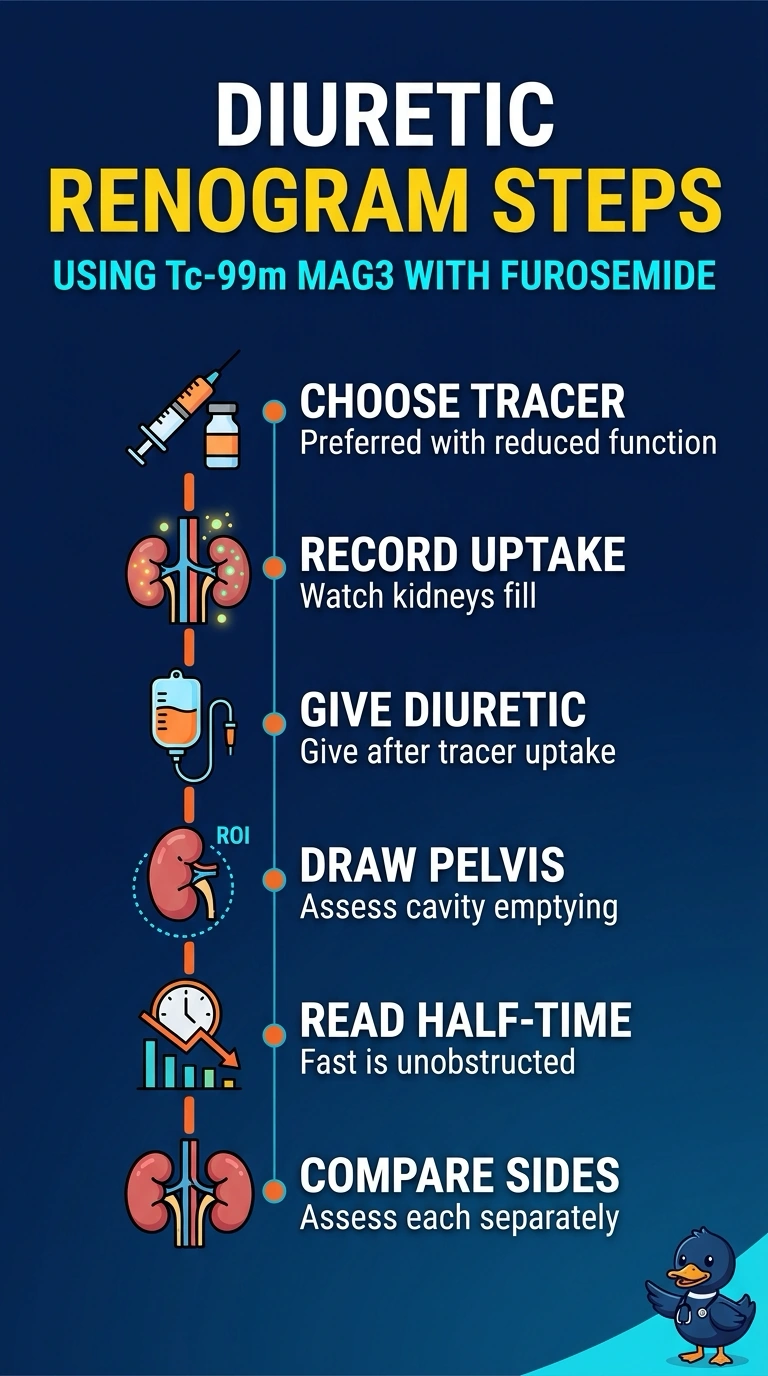
When your kidney has poor function, MAG3 is a better tracer choice than DTPA because its higher tubular extraction can give you clearer images. After it’s taken up, furosemide acts like a pressure test, and timing drainage from a separate renal pelvic region of interest tells you whether the dilated system empties freely.
Full Explanation
Diuretic renography assesses whether the collecting system empties when challenged with increased urine flow. Tc-99m MAG3 is generally preferred over DTPA when renal function is reduced because its tubular extraction is higher, which can provide better image quality in that setting. Giving furosemide after tracer uptake provokes diuresis while activity is still in the kidney, and quantifying drainage from a region drawn over the renal pelvis provides a numerical drainage measure for the collecting system. The result supports assessment of whether a dilated pelvis drains freely or is obstructed, but should be interpreted with the images and other relevant findings rather than in isolation. DTPA is less suitable in reduced renal function because its lower extraction can result in poorer image quality. A whole-kidney region includes both parenchymal retention and pelvic emptying, so it does not isolate collecting-system drainage. Omitting the diuretic does not provide the required challenge to drainage. Exam caveat: timing and region placement vary by department, so hold on to the concept rather than a specific minute. Practical check: confirm the tracer fits the function level before you draw the regions and read the curve.