
A nuclear pharmacy notices that after a molybdenum-99 and technetium-99m generator is eluted, the measurable Tc-99m yield climbs for about a day and then declines. Which physical principle accounts for the rise and fall of the daughter activity?
Select an answer to reveal the explanation.
Short Explanation
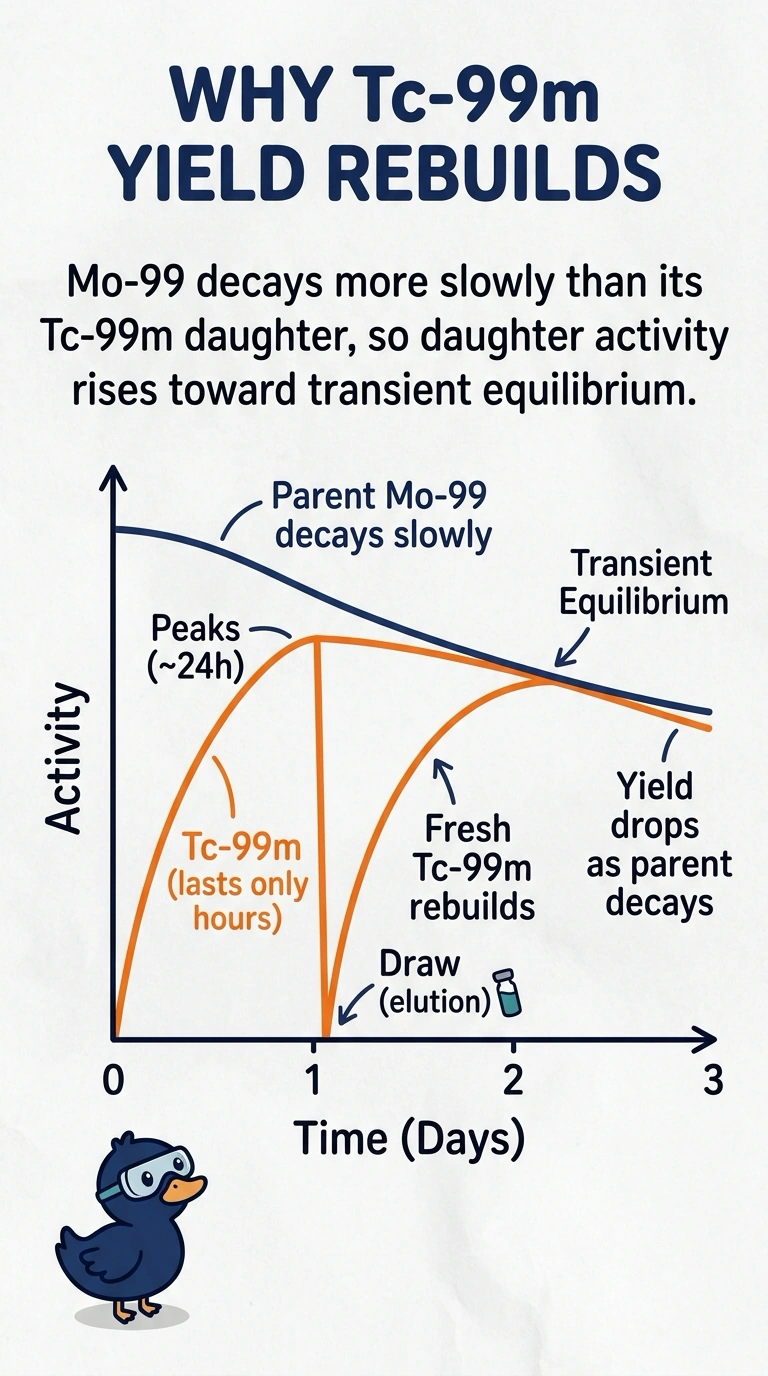
Mo-99 has a longer half-life than its Tc-99m daughter, so it keeps replenishing Tc-99m after elution—like a slowly filling reservoir. Your Tc-99m activity rises toward transient equilibrium, then declines as Mo-99 decays.
Full Explanation
A molybdenum-99 and technetium-99m generator is a parent-daughter system in which the parent, with a half-life near 66 hours, decays into a daughter whose half-life is about 6 hours. Elution removes most of the daughter, so immediately afterward the parent produces Tc-99m faster than the daughter initially decays. Daughter activity rises to a peak, typically about a day after elution, and then declines as the parent decays; after transient equilibrium is established, the daughter activity follows the parent’s decay. This is why generators are commonly eluted about daily, although the schedule depends on operational needs. Reversing the half-lives makes the daughter the longer-lived species, which contradicts the parent-daughter relationship. Blaming loosely held pertechnetate and a regenerating resin confuses chemical binding with radioactive production: Tc-99m is created by decay and leaves as pertechnetate during elution. Attributing the rise to dose calibrator drift is a legitimate instrument concern, but drift would not explain the expected ingrowth pattern after elution. Practical check: log elution times and yields together so the ingrowth curve and expected peak are visible before scheduling patients.