
After a total thyroidectomy for papillary thyroid cancer, a patient has a rising thyroglobulin and uptake in both lungs on a diagnostic iodine scan, so radioiodine therapy is scheduled. The department must give the therapy dose and then image where the administered activity localizes before the next course is planned. Which treatment plan best delivers the therapy dose and images where the activity goes?
Select an answer to reveal the explanation.
Short Explanation
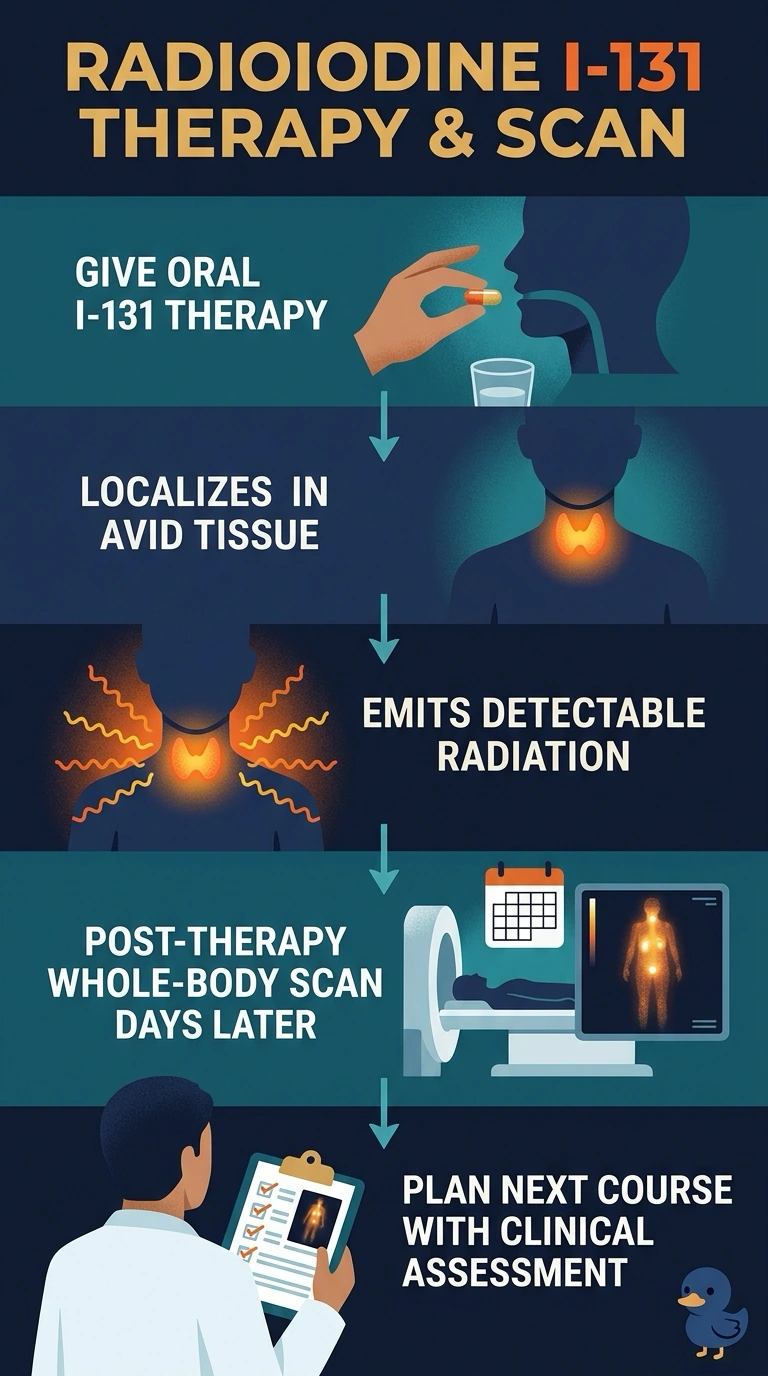
You’ll give oral I-131 therapy, then get a post-therapy whole-body scan several days later to see where the activity settles—like tracking a package after it’s sent. The post-therapy scan shows the treatment’s distribution, unlike a diagnostic scan taken before therapy or an ultrasound.
Full Explanation
Oral I-131 therapy is appropriate because residual thyroid tissue and iodine-avid papillary thyroid cancer metastases can take up the administered radioiodine, allowing it to deliver treatment to those sites. A post-therapy whole-body scan uses the activity actually given for treatment and shows where it localizes, including sites beyond the neck; it is generally acquired several days later. A diagnostic tracer whole-body scan is a diagnostic imaging approach: it maps tracer uptake, not the distribution of the therapeutic administration specified here, and reviewing it before treatment does not meet the requirement to image the therapy dose. Serial neck ultrasound is an anatomic surveillance approach; it can assess structures in the thyroid bed but cannot show whole-body radiopharmaceutical distribution or uptake in lung metastases. Fractionated external beam radiation is a localized radiation treatment approach, not radioiodine administration, so it cannot provide an image of where administered I-131 localizes. Exam caveat: the post-therapy scan timing varies by protocol, so “several days later” is not a fixed interval. Practical check: confirm that the patient received oral I-131 therapy and that the planned follow-up study is a post-therapy whole-body scan, rather than a diagnostic tracer scan or neck-only ultrasound.