
After a small Tc-99m eluate spill, staff wipe and decontaminate the dose bench and then must document that any removable activity is below the site's action level. The lab holds an ion chamber, a thin-window Geiger-Muller probe, a sodium iodide well counter, and a dose calibrator. Which instrument and method should verify removable contamination on the bench?
Select an answer to reveal the explanation.
Short Explanation
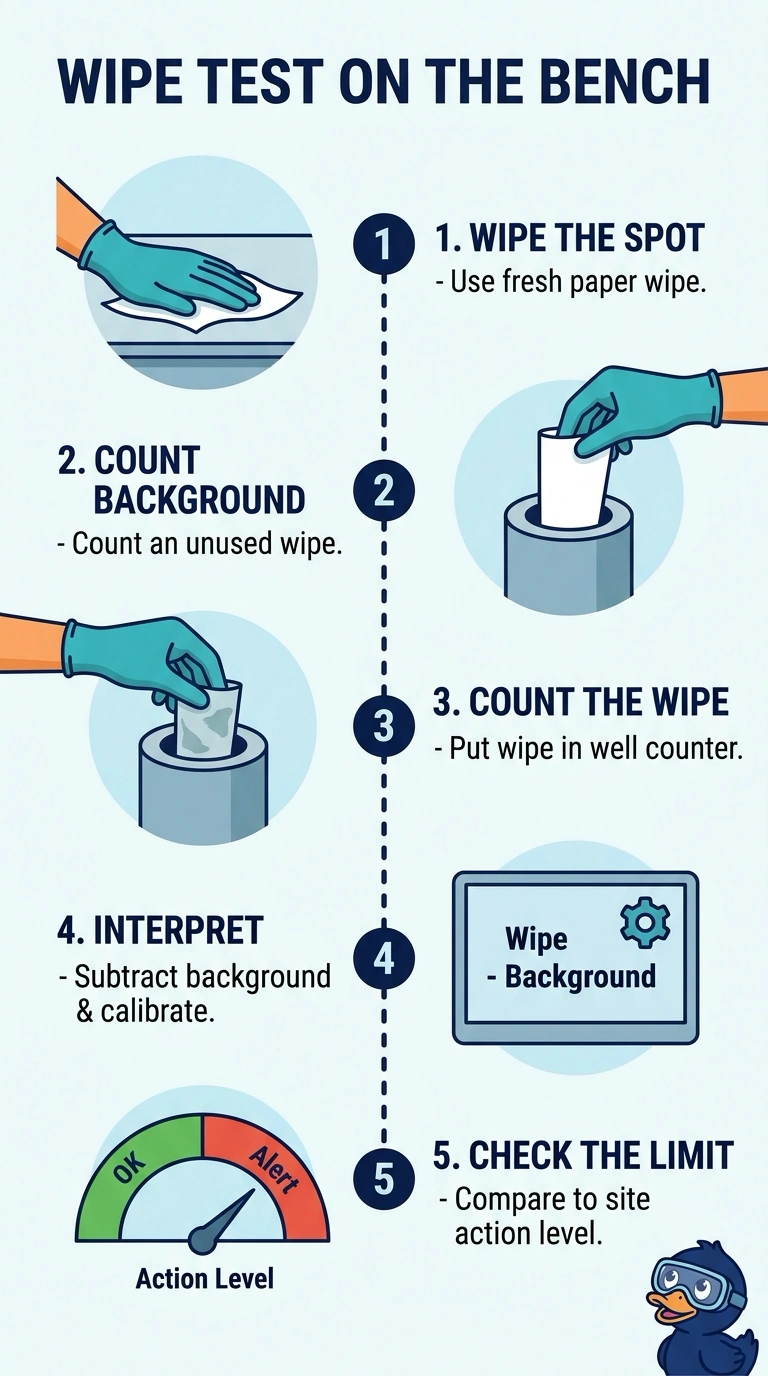
You can treat the bench wipe like a tiny sponge that collects what you’re checking: count it in the sodium iodide well counter. Subtract background, use the counter’s calibration, and compare the result with your site’s action level.
Full Explanation
A wipe test samples activity that can be removed from the bench; counting the wipe in the sodium iodide well counter is a standard, sensitive way to quantify the collected Tc-99m. Subtracting background and applying the counter calibration makes the result interpretable, and comparison with the site's action level answers the stated documentation requirement. A thin-window Geiger-Muller probe is commonly used for direct contamination surveys, but scanning the surface measures radiation from activity present at the surface, including activity that may be fixed; it does not establish how much activity is removable by wiping. A dose calibrator is routinely used to assay radiopharmaceutical activity, but its Tc-99m vial calibration is for a specified container and geometry. A wipe has a different geometry and may yield a biased activity estimate unless the instrument has a validated calibration for that configuration, so the stated method does not reliably quantify the wipe. The well-counter approach is appropriate, but substituting a generic published limit for the site's action level fails the explicit site-specific comparison requirement. Exam caveat: direct surveys and wipe tests answer different questions, and neither should be treated as interchangeable. Practical check: confirm the counter's wipe geometry calibration, background procedure, units, and current site action level before recording the result.