
A patient is booked for In-111 octreotide scintigraphy, but the camera still has the low-energy collimator from a Tc-99m bone study. The tracer's photopeaks sit at 171 and 245 keV. Which collimator and window setup best preserves image quality for this study?
Select an answer to reveal the explanation.
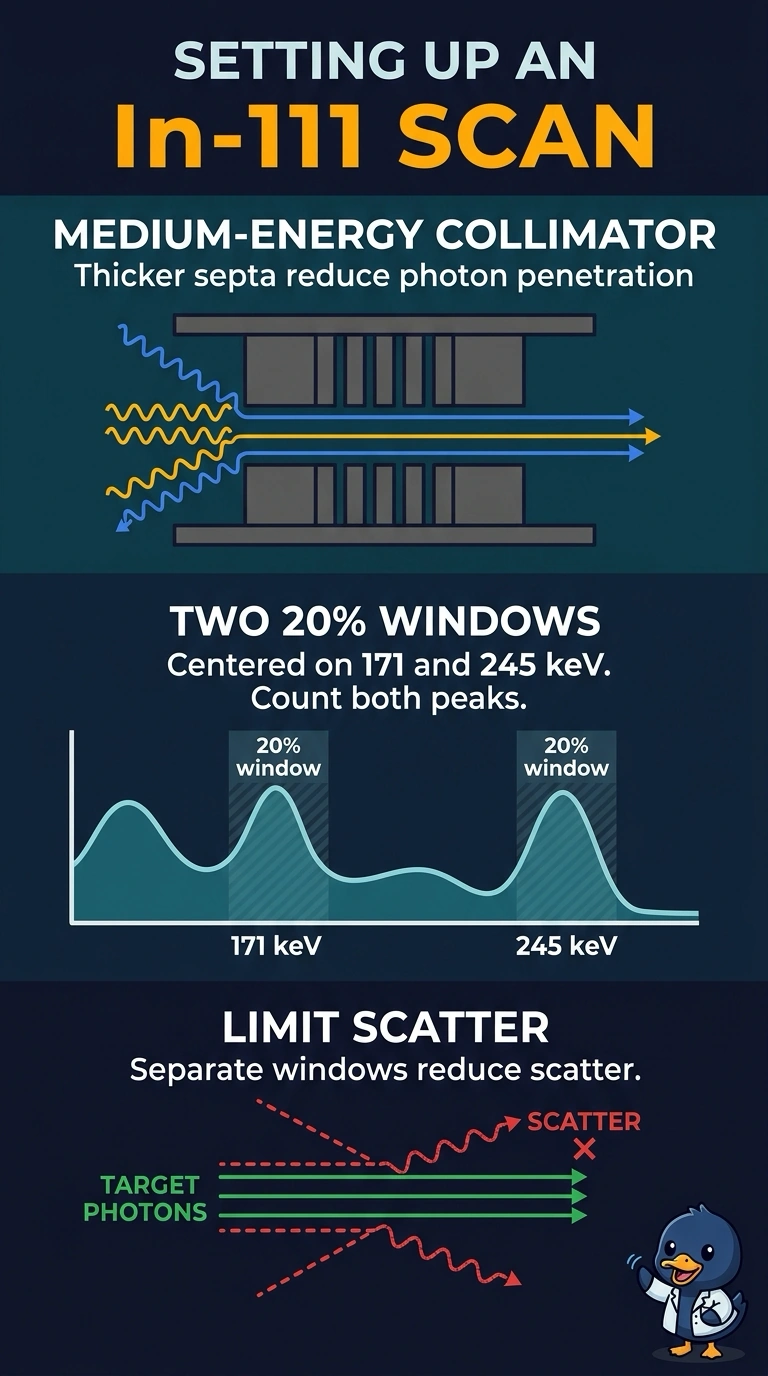
Short Explanation
You’ll want a medium-energy collimator because a low-energy one is like a sieve with openings that are too wide, letting photons blur the image. Set separate 20% windows centered at 171 and 245 keV to capture both photopeaks while limiting scatter.
Full Explanation
Collimator choice is an energy-matching decision, because septal thickness and hole length affect how much photon penetration and image degradation occur. In-111's 171 and 245 keV photons are above the design range of a low-energy collimator, so a medium-energy design with thicker septa reduces penetration and preserves image quality. Separate windows over each photopeak help reject scatter and improve contrast, though they do not eliminate all scattered photons. A low-energy collimator risks greater septal penetration at these energies. A high-energy collimator is designed for higher-energy photons and may reduce resolution and sensitivity for this study. One broad window admits more inter-peak and scattered photons, which can reduce target-to-background contrast. Practical check: read the collimator's energy rating on its frame before you drape the patient.