
A training session uses a technetium-99m source to show how gamma photons interact in tissue. One photon strikes a K-shell electron in a soft tissue atom, disappears completely, and ejects the electron with energy equal to the photon energy minus the binding energy. Which interaction is being demonstrated?
Select an answer to reveal the explanation.
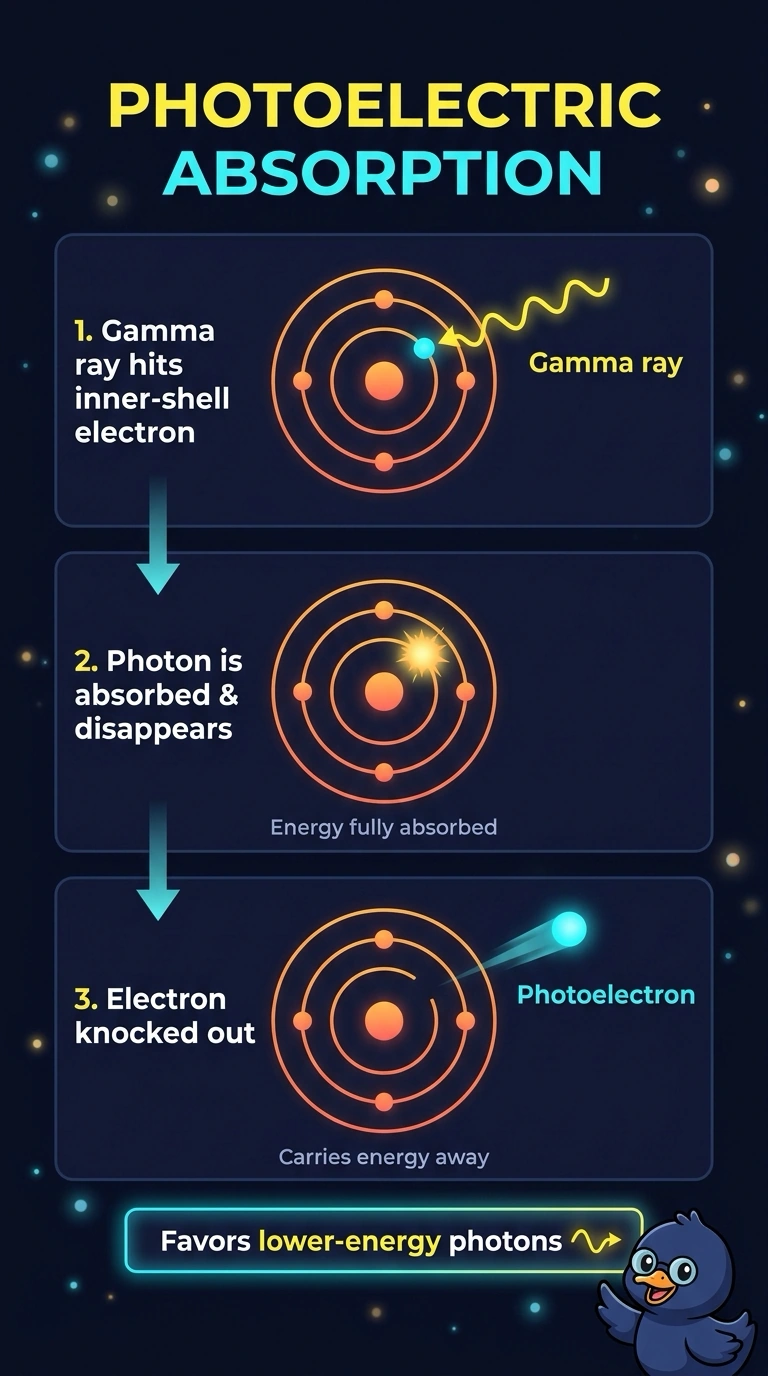
Short Explanation
You found the giveaway: the photon vanishes and hands everything to a bound electron, which is the signature of photoelectric absorption. It's like a cue ball that stops dead after sinking the eight ball, leaving nothing to scatter away.
Full Explanation
Photoelectric absorption is an all-or-nothing event: the incident photon transfers its entire energy to a tightly bound inner-shell electron and ceases to exist, while the ejected photoelectron leaves with the photon energy minus the binding energy. This interaction grows more likely as photon energy falls and as the atomic number of the material rises, which is why lead sheet stops low-energy photons so efficiently. Compton scattering fails here because it is a partial-energy exchange with a loosely bound electron, leaving a scattered photon that continues onward with reduced energy. Coherent scattering fails because the atom re-radiates the photon at unchanged energy and no electron is freed. Pair production fails on threshold grounds, since it needs photon energy above the 1.022 MeV rest-mass floor and yields an electron-positron pair, whose positron later undergoes annihilation into two 511 keV photons. Exam caveat: questions often pair a high-atomic-number material with low photon energy to point at the photoelectric effect, so weigh both variables together. Practical check: whenever a stem describes a photon that disappears while a bound electron keeps nearly all its energy, choose photoelectric absorption.