
During a busy morning in an outpatient nuclear medicine department, a patient waiting for a hepatobiliary study is hard of hearing, depends on lip reading, and the waiting area is loud. You must explain the delayed imaging steps and confirm the patient understands before the tracer is injected. Which communication approach best combines verbal and nonverbal modes for this patient?
Select an answer to reveal the explanation.
Short Explanation
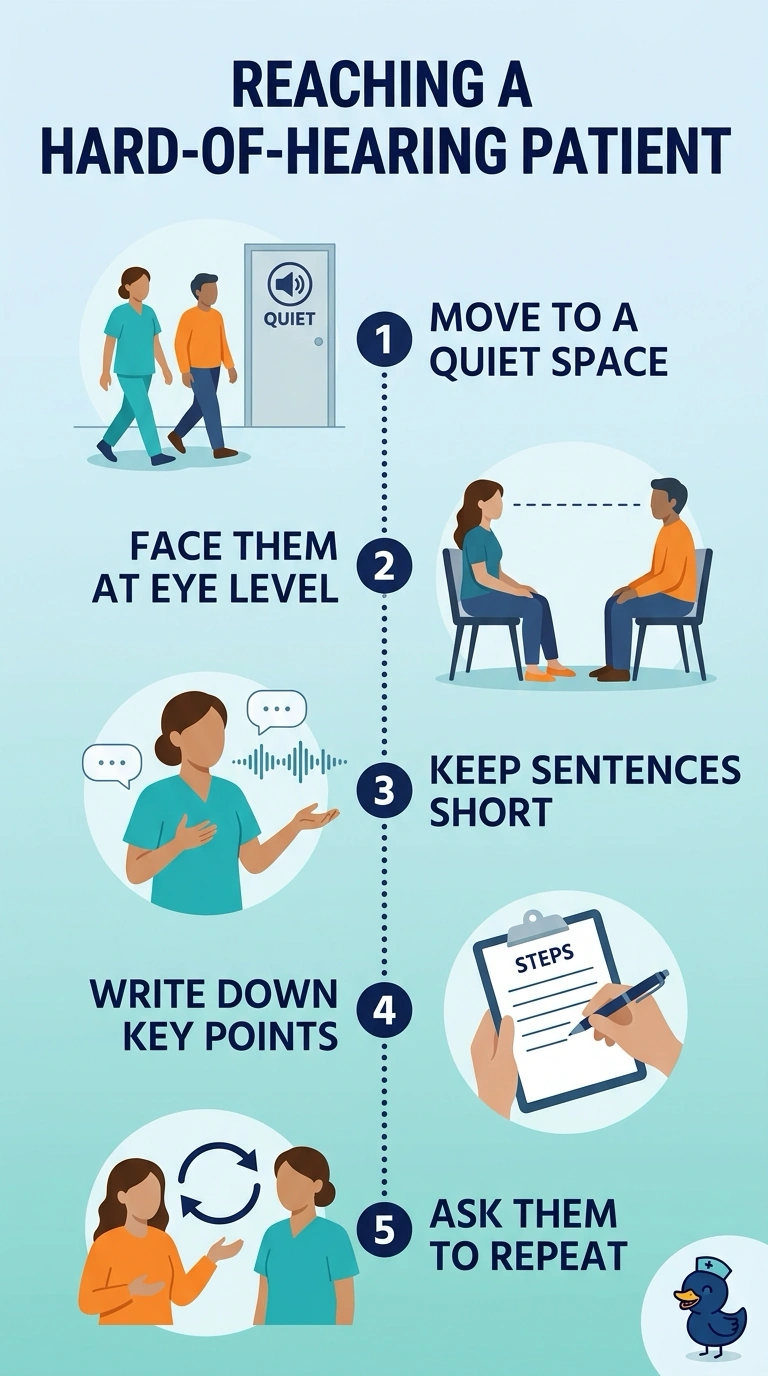
Your setup matters more than your volume here. Facing the patient at eye level supports lip reading, and written key points plus asking them to explain the next step help you check understanding. That’s where nonverbal cues earn their keep.
Full Explanation
The best approach reduces competing noise, supports lip reading by keeping you at the patient’s eye level, and combines concise spoken instructions with written key points the patient can review. Asking the patient to explain the next step is teach-back: it checks what they understood rather than simply whether they feel they understood, allowing you to correct confusion about the delayed imaging sequence before injection. Asking only whether the instructions are clear includes the quiet setting, eye-level face-to-face communication, speech, and written support, but is not a reliable confirmation; a patient may agree without being able to describe the plan. Explaining each step aloud and using teach-back provides a suitable setting and checks understanding, but omits written key points, removing a useful visual reference for a patient who is hard of hearing. Standing while facing the patient and providing spoken steps, written points, and teach-back includes the other supports, but being above the patient’s eye level may make lip reading less effective. Exam caveat: frame teach-back as a check on how clearly you explained the plan, not as a test of the patient. Practical check: before injection, ask the patient to describe the next imaging step and verify that their account matches the intended sequence.