
A follow-up PET/CT shows SUV values shifted from the prior study even though the reconstructed and attenuation-corrected images look normal and both the scanner's daily quality control and the dose calibrator constancy check passed this morning. Which calibration check should the department perform first to explain the quantitative mismatch?
Select an answer to reveal the explanation.
Short Explanation
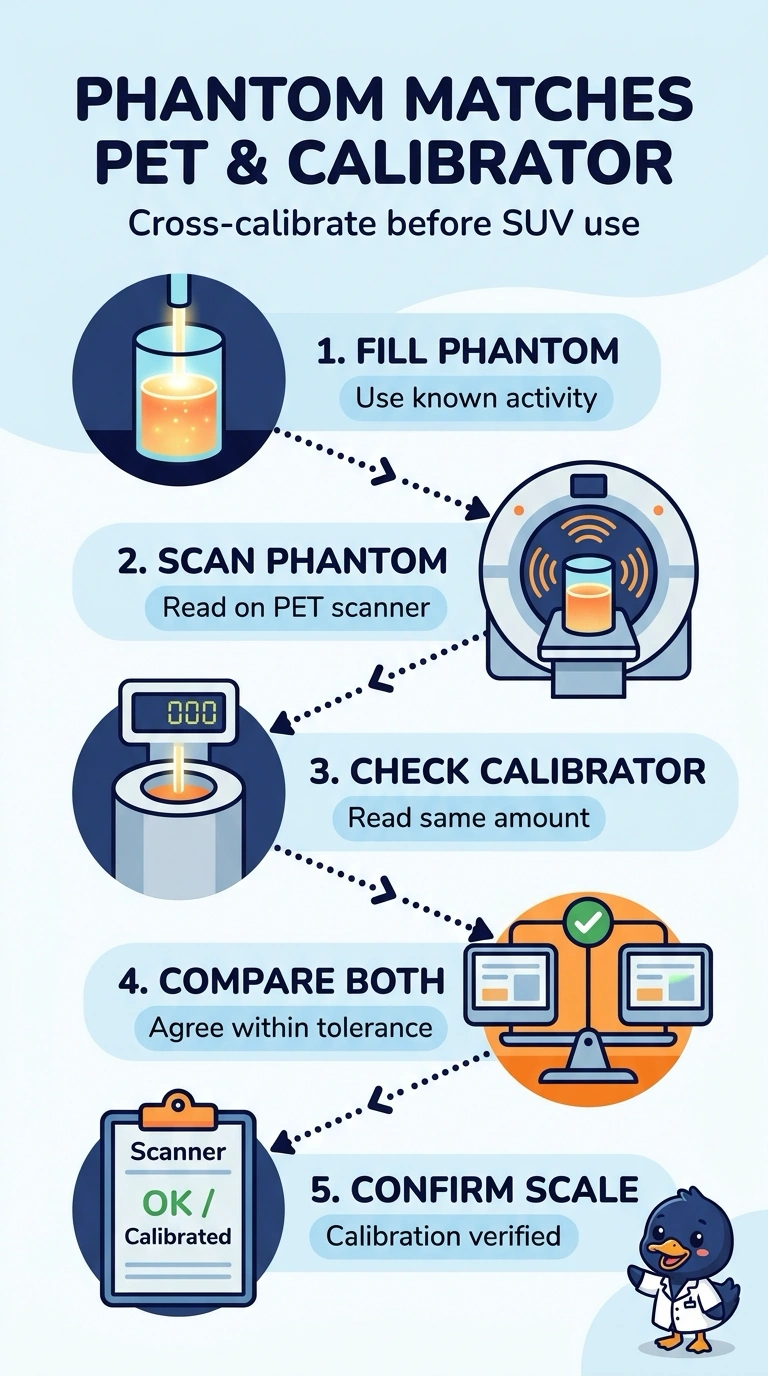
Your SUV values depend on the scanner and dose calibrator reading activity on the same scale. Like matching two rulers before measuring, a filled-phantom cross-calibration checks that agreement before you use SUVs.
Full Explanation
An SUV depends on the scanner converting coincidence counts into activity concentration and on the syringe being assayed correctly, so both devices must be anchored to the same standard. A filled cross-calibration phantom holding a known activity is counted by the PET detector and measured by the dose calibrator, and comparing the two readings exposes drift before it distorts patient values, with the department's tolerance defining acceptance. Repeating daily system quality control checks components that form the image, such as the 511 keV energy peak, uniformity and sensitivity, but it generally does not establish whether the scanner reports absolute activity correctly, and it already passed this morning. Recalibrating the CT attenuation scale addresses conversion of Hounsfield units used for attenuation correction rather than the quantitative relationship between scanner and dose calibrator, so images can look fine while SUVs stay wrong. An accuracy test with traceable sources confirms that the dose calibrator matches national standards, but it still cannot reveal disagreement between the two units. Exam caveat: vendor quality control schedules and acceptance limits change over time, so follow your scanner's written plan. Practical check: compare the phantom reading on the scanner with the dose calibrator reading and confirm the difference sits inside tolerance before the next patient.