
The daily constancy check on a dose calibrator has read low for three straight days. The reference source is still the original one, the instrument has had no service work, and readings on the other nuclide settings remain unchanged. Which test should be performed next to determine whether the reference source or the instrument is responsible?
Select an answer to reveal the explanation.
Short Explanation
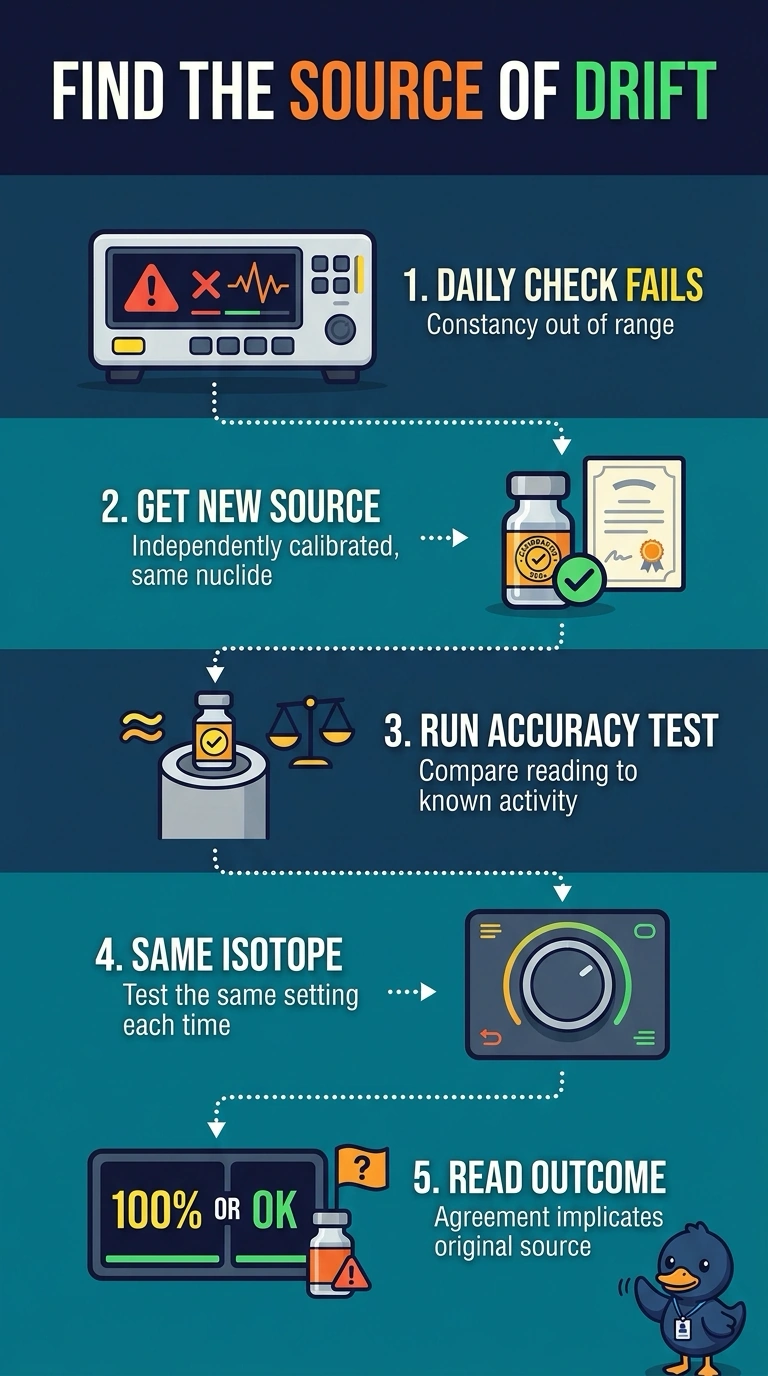
Three failing daily checks in a row mean you'll need a second opinion from a source you trust. An accuracy test against an independently calibrated source checks the calibrator against a known activity, like checking a scale against a certified weight.
Full Explanation
Constancy is a trend check on one known source, so when it drifts day after day with nothing repaired, the question becomes which end of the measurement is wrong. An accuracy test answers that by comparing the calibrator with an independently calibrated source of the same nuclide. If the calibrator reading agrees with that source's known activity, the original reference source or its recorded activity is suspect; if it does not, the instrument may be at fault. The linearity approach fails because a decay or dilution series evaluates how the reading behaves across the activity range, and it cannot separate a bad source from a drifted response at a single point. The geometry approach fails because swapping syringe volumes and container types checks how position and volume affect the reading, rather than resolving this source-versus-instrument question. Repeating the daily constancy check fails because re-measuring the same suspect source only confirms the discrepancy without giving you an independent reference. Follow applicable regulatory requirements and your facility's approved procedures for acceptance limits and test frequency. Practical check: keep the constancy log beside the source details so a drift shows up as a trend long before it reaches a patient.