
During a protocol in-service, a student argues that the organ showing the greatest uptake on a bone scan must also be the organ receiving the highest radiation dose. The agent in question shows strong cortical bone uptake, yet a sizable fraction is cleared by the kidneys and dwells in the bladder until the patient voids. Which statement correctly distinguishes the target organ from the critical organ for this agent?
Select an answer to reveal the explanation.
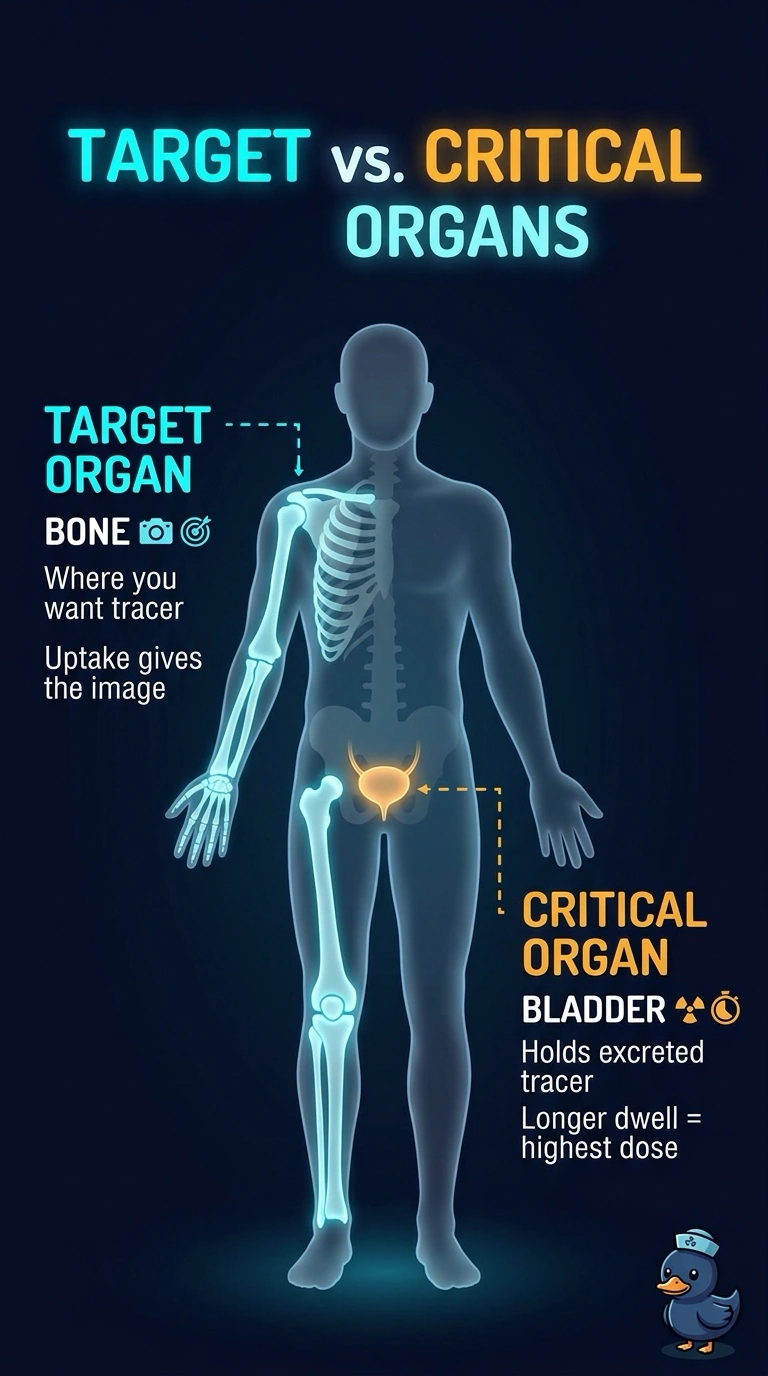
Short Explanation
Uptake and dose answer two different questions, and that split is why the answer isn't a single organ. You image the skeleton, while the bladder holds the cleared activity until the patient voids, so it takes the highest absorbed dose. It's like a parade route versus a parking lot: you watch the route, but the idling cars at the lot collect the most exhaust.
Full Explanation
The target organ and the critical organ answer two different questions. The target organ is the structure the study is designed to image, selected because the agent concentrates there and gives the count density you need, so for this agent the skeleton is the target. The critical organ is the tissue receiving the highest radiation dose per unit of administered activity, which depends on how much activity reaches it, how long it stays and how slowly physical decay removes it. That is why activity cleared by the kidneys and then pooled in the bladder until voiding can out-dose a tissue that looks busier on the image. Calling bone critical because its uptake looks greatest confuses uptake percentage with residence time, which is the most common slip on this topic. Making clearance the defining feature of the critical organ mistakes a transport route for a dose sink, and treating any first-pass structure as a target ignores that the target is chosen for imaging intent rather than blood flow. The exam caveat is that critical organ assignments come from modeled biokinetics, so two agents with similar images can list different critical organs. A practical check: ask first where you want the tracer to be, then ask where it lingers longest before it leaves the body.