
A patient with a 5 mm ureteral stone, new hydronephrosis and rising creatinine is referred to nuclear medicine. Urology needs to know whether the kidney is obstructed and how much function each kidney contributes before deciding on surgery. Which renogram study best fits this referral?
Select an answer to reveal the explanation.
Short Explanation
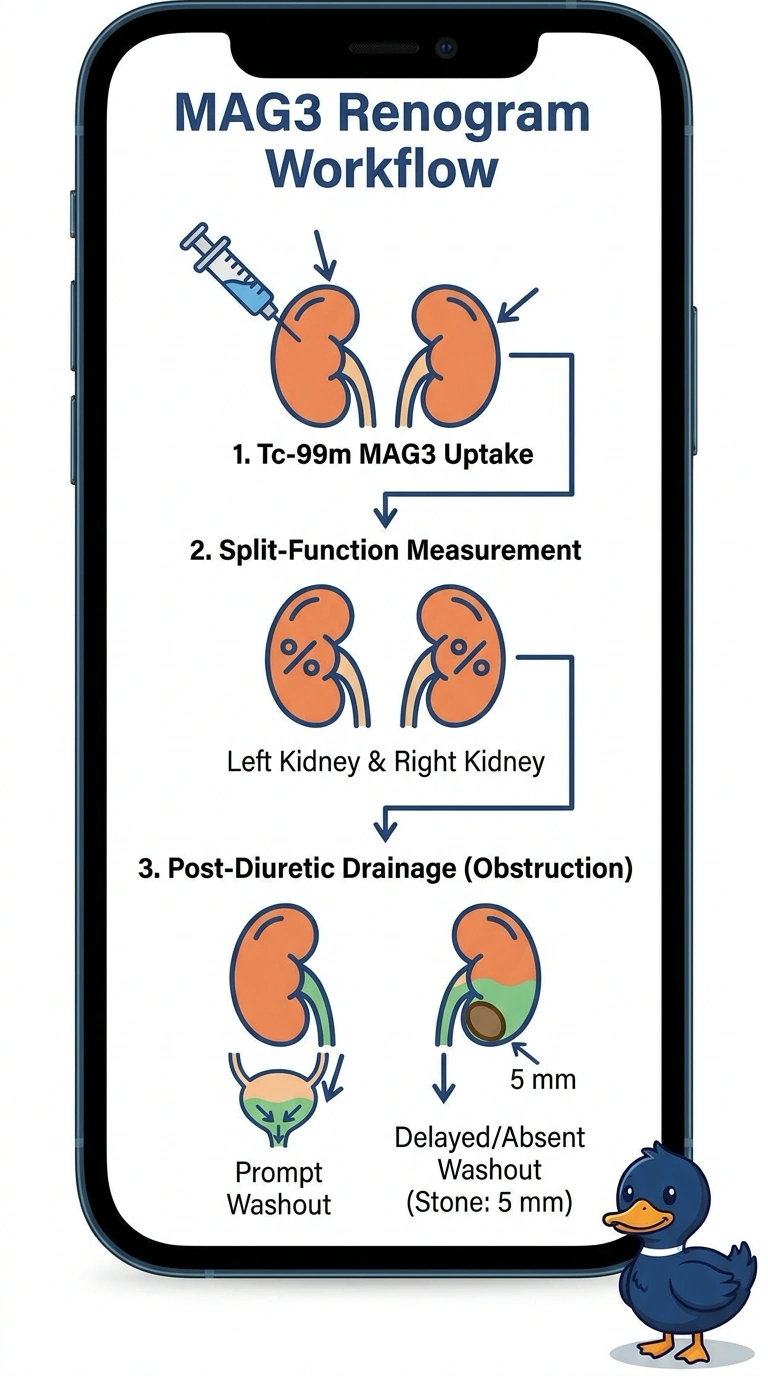
You need to know whether urine is draining and how much each kidney contributes—like checking both the plumbing and the pump. A Tc-99m MAG3 diuretic renogram measures uptake and split function, then shows drainage after a diuretic.
Full Explanation
A Tc-99m MAG3 renogram with a post-diuretic phase addresses both clinical questions: relative uptake provides differential (split) renal function, while tracer transit and response to diuresis help assess whether drainage is obstructed. MAG3 is extracted efficiently by tubular secretion, making it a useful choice when renal function is impaired, as may be relevant with a rising creatinine. DTPA diuretic renography is a legitimate functional study and can measure split function and drainage, but DTPA depends on glomerular filtration; reduced filtration can produce poorer count statistics and less dependable assessment in this patient, so it is a less suitable choice. DMSA cortical imaging is commonly used to assess cortical defects and differential cortical uptake, but it is not a drainage study and cannot answer the obstruction question. A MAG3 study without a diuretic challenge can show uptake and baseline transit, yet slow drainage may reflect a dilated collecting system or reduced function rather than obstruction; it therefore does not reliably settle the requested drainage question. Exam caveat: no single renogram curve should be interpreted without considering renal function, hydration, bladder emptying, and collecting-system anatomy. Practical check: confirm that the requested protocol includes both differential-function quantification and an appropriate diuretic drainage assessment.