
A patient with heart failure and a healed anterior infarct is scheduled for Tc-99m PYP scintigraphy for suspected ATTR cardiac amyloidosis. The protocol already includes planar imaging plus SPECT, but the requisition arrives without any laboratory studies and orders an overnight fast with insulin held for a same-day FDG comparison. Which preparation is required before this PYP study can be interpreted as supporting ATTR cardiac amyloidosis?
Select an answer to reveal the explanation.
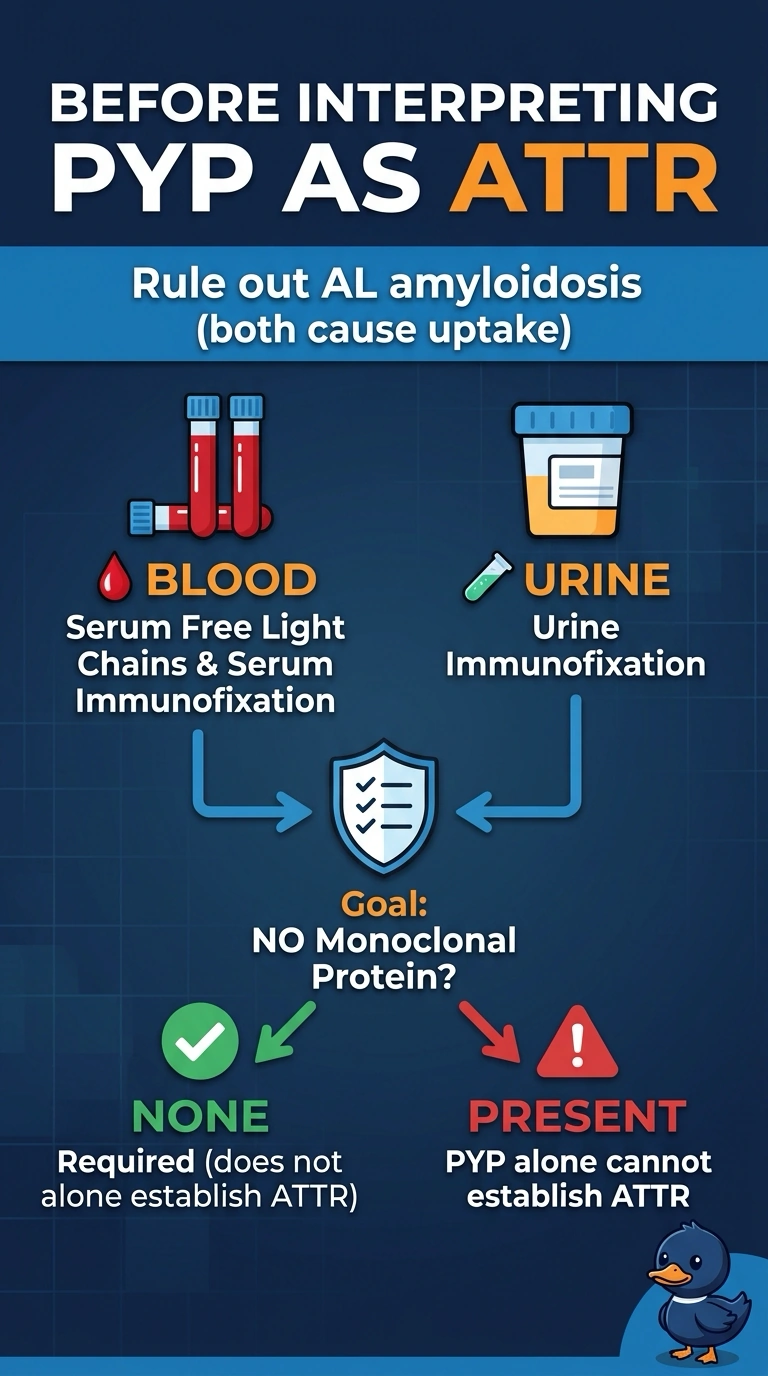
Short Explanation
PYP uptake alone can’t tell ATTR amyloidosis from light-chain (AL) amyloidosis—it’s like seeing a clue that fits two cases. Before your scan can support ATTR, confirm that serum free light-chain testing and serum and urine immunofixation show no monoclonal protein.
Full Explanation
A nonbiopsy diagnosis of ATTR cardiac amyloidosis requires an appropriate clinical context, grade 2 or 3 myocardial uptake on PYP imaging, and exclusion of a monoclonal protein by serum free light-chain testing and serum and urine immunofixation. PYP uptake can occur in both ATTR and AL amyloidosis, so uptake intensity or the heart-to-contralateral ratio cannot distinguish the two. If the monoclonal protein evaluation is abnormal or indeterminate, PYP imaging alone cannot establish ATTR; further evaluation, often including tissue biopsy with amyloid typing, is needed. Overnight fasting and insulin management are relevant to FDG imaging, not PYP imaging, and insulin should not be withheld without appropriate clinical direction. Echocardiography can provide supportive information but does not exclude AL amyloidosis. Hydration and voiding may be reasonable routine advice but do not address the diagnostic requirement. The history of infarction also matters when interpreting uptake, since focal uptake related to infarction can complicate interpretation; SPECT helps assess whether uptake is truly myocardial. A negative monoclonal protein evaluation is necessary, but it does not by itself establish ATTR.