
A radiopharmacy reviews a stock radionuclide solution before releasing it for kit preparation. Assay activity, sterility and pH all pass, and the reviewer still must document that the radioactivity is the intended nuclide. Which measurement establishes radionuclidic purity for this release?
Select an answer to reveal the explanation.
Short Explanation
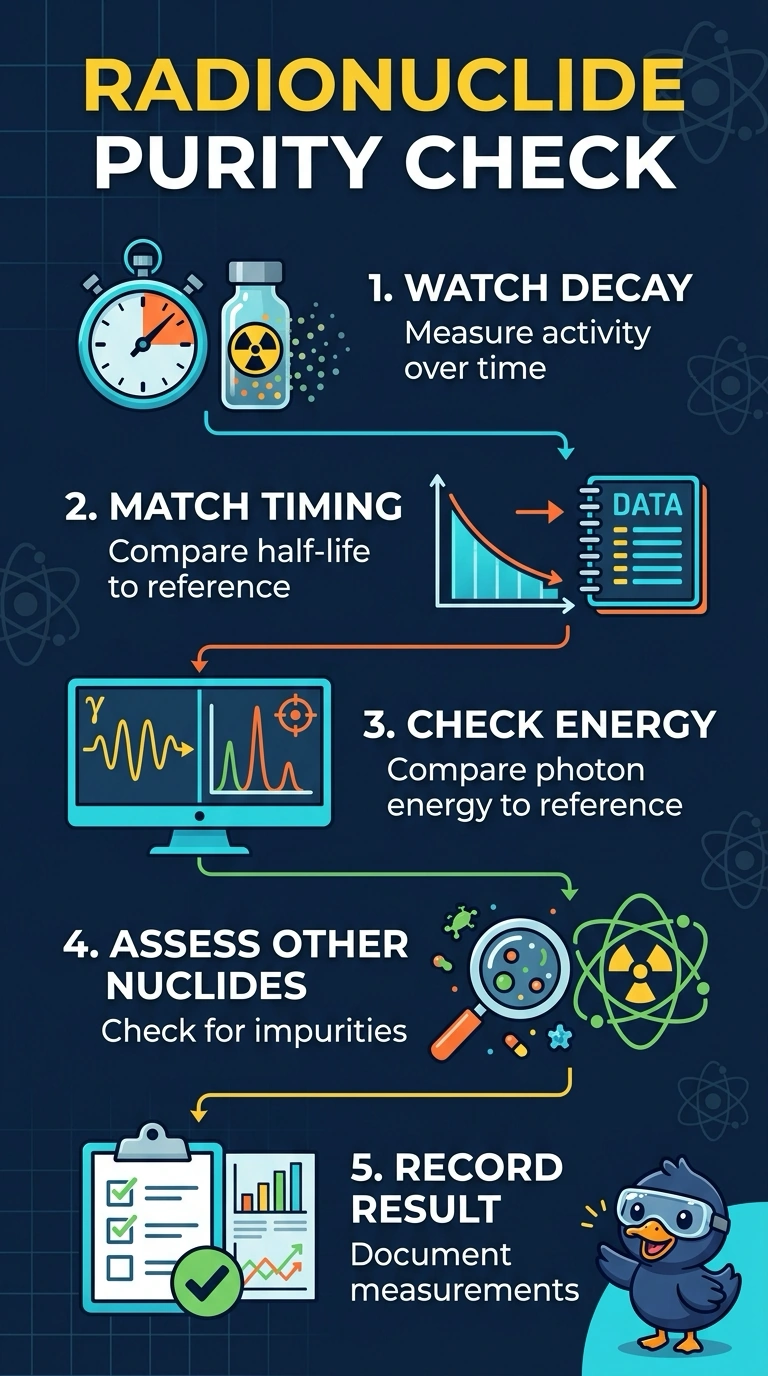
Assaying the vial tells you how much activity you have, not which nuclide is producing it. Radionuclide identity can be assessed by measuring the decay rate and, for photon-emitting nuclides, comparing characteristic photon energies with reference values. A half-life measurement is useful evidence, but it does not by itself prove that no other radionuclide is present.
Full Explanation
Radionuclidic purity is the proportion of the radioactive content attributable to the intended radionuclide. It is assessed using measurements that identify radionuclides, such as gamma-ray spectrometry and, where appropriate, decay-rate measurements compared with reference values. Half-life and photon energies can support identification, but neither alone proves that no other radionuclide is present; the appropriate method and acceptance limits depend on the product and applicable procedures. Chromatography answers a different question: which chemical species the activity is attached to, which concerns radiochemical purity. A dose calibrator assay measures activity at a stated time, not radionuclide identity. Well counting across an imaging energy window measures count rate under specified conditions and does not by itself establish radionuclidic purity. Follow the product labeling and applicable procedures for the required tests and limits.