
Two patients are scheduled this morning for the same perfusion study, and a shielded unit dose was drawn at the calibrator forty minutes ago before you reached the suite. Before you enter the patient's room, which label details must you confirm to complete the unit dose verification?
Select an answer to reveal the explanation.
Short Explanation
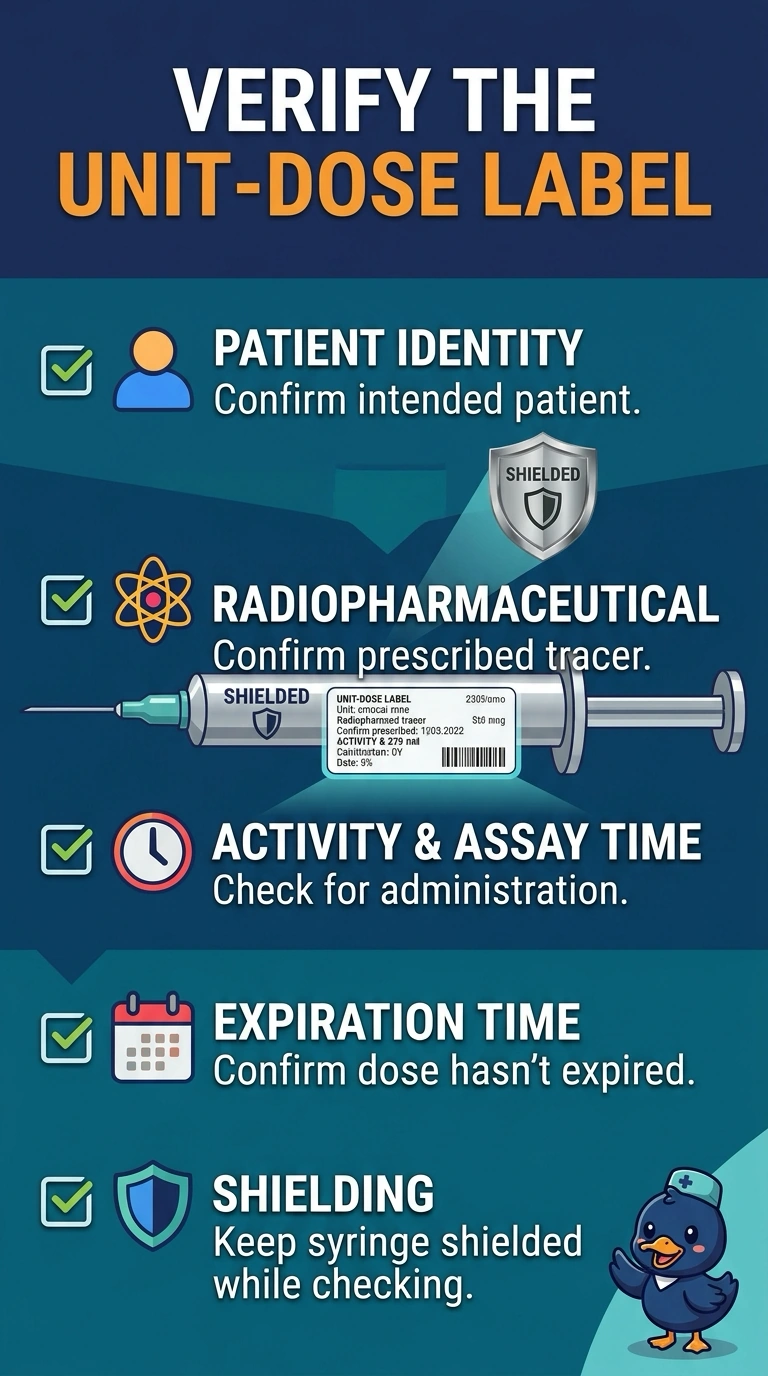
Your dose label is like a timed receipt: confirm the patient and radiopharmaceutical, then check the activity and assay time against the order and planned administration. Make sure the expiration time hasn’t passed, too—those details complete your unit dose verification.
Full Explanation
Complete unit dose verification by confirming the patient and radiopharmaceutical identifiers, along with the activity, assay time, and expiration time. Together, these details match the dose to the intended patient and study, establish the activity at its recorded assay time, and show whether the dose remains usable for the planned administration. A label with the radiopharmaceutical, activity, assay time, and expiration time but no patient identifier cannot establish whose dose you are handling, even when two patients are scheduled for the same study. A label with the patient and radiopharmaceutical, activity, and expiration time but no assay time does not show when the activity was measured; expiration alone cannot supply that information when administration is delayed. A label with the patient and radiopharmaceutical, activity, and assay time but no expiration time cannot confirm that the dose remains within its labeled period of use. Exam caveat: preparation time and assay time are not interchangeable unless the label or applicable procedure explicitly defines them that way. Practical check: read the label directly, match the patient and radiopharmaceutical to the order, and verify the activity, assay time, and expiration against the planned administration before entering the room.