
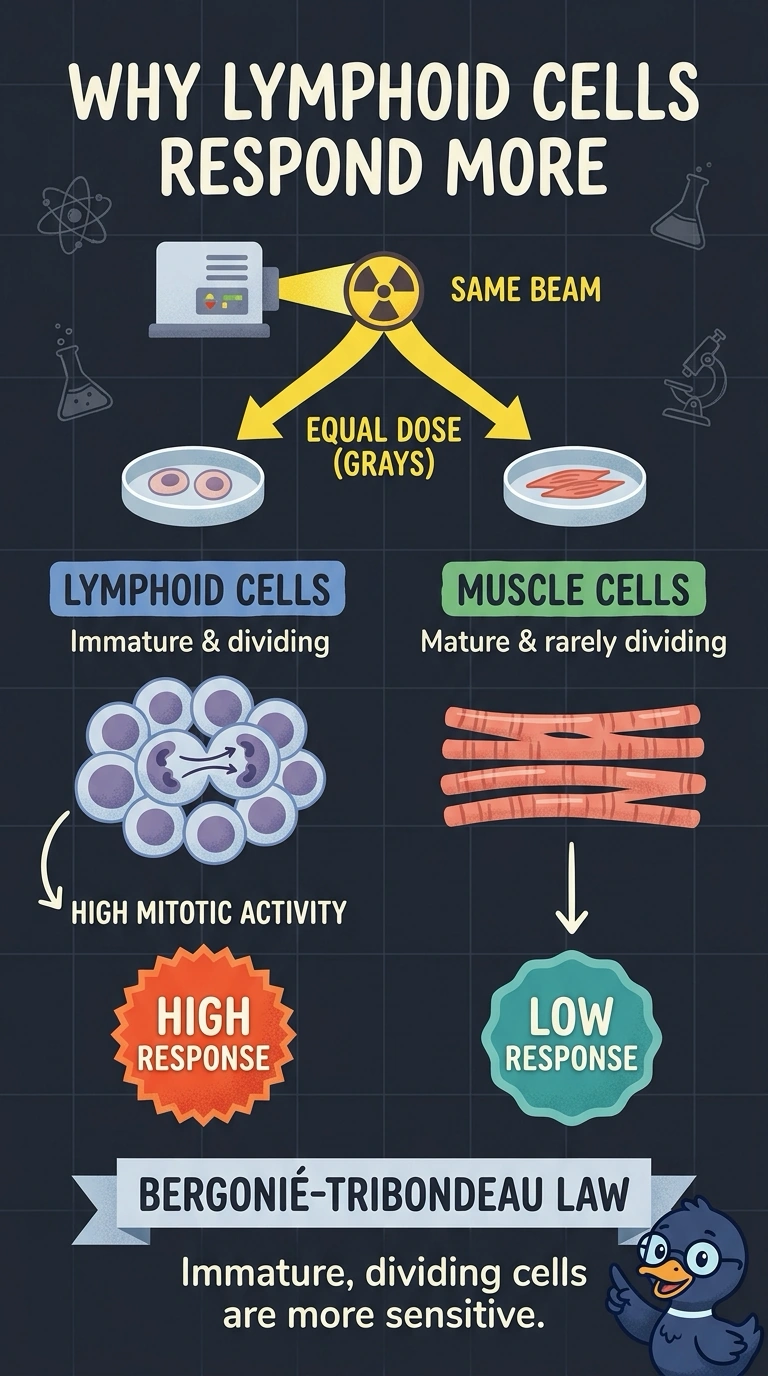
In a radiation biology exercise, two tissue samples receive the same absorbed dose from the same low-energy x-ray beam: one is lymphoid tissue packed with dividing, immature cells, the other is mature skeletal muscle. Which prediction of their relative response correctly combines LET, RBE and the Bergonie-Tribondeau law?
Select an answer to reveal the explanation.
Short Explanation
You’d expect the lymphoid tissue to respond more because its cells are immature and dividing, while muscle cells are more mature. It’s like fast-growing plants being more vulnerable to a harsh change: the Bergonie-Tribondeau law predicts this difference, while the same beam means both samples have the same radiation quality.
Full Explanation
Because both samples receive the same absorbed dose from the same beam, the radiation quality is shared; the expected difference in response is due to the tissues' radiosensitivity. The Bergonie-Tribondeau law describes greater radiosensitivity in cells with high mitotic activity and little differentiation. Lymphoid tissue is generally more radiosensitive than mature skeletal muscle. X-rays are low-LET radiation, but RBE is not determined by LET alone and can vary with photon energy, tissue and biological endpoint; it should not be assumed to be near 1 for every low-energy x-ray beam. Equal absorbed dose does not guarantee equal biological effect, because the gray measures energy absorbed per unit mass, not the tissue's response to that energy.