
A 48-year-old with primary hyperparathyroidism is scheduled for a two-phase neck study this afternoon. The protocol calls for a lipophilic cation that diffuses into mitochondria-rich cells and clears from normal thyroid faster than it clears from an adenoma. Which radiopharmaceutical matches that localization mechanism?
Select an answer to reveal the explanation.
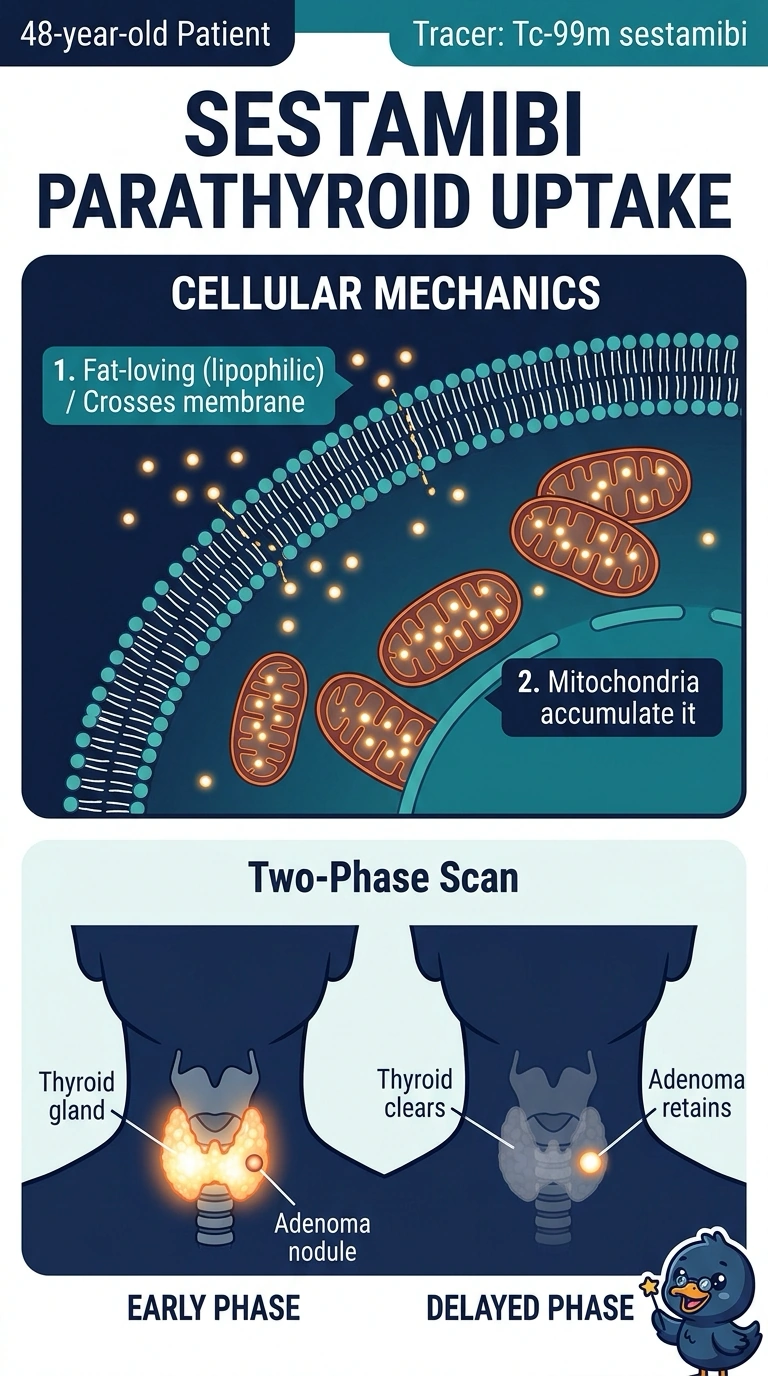
Short Explanation
Your match is Tc-99m sestamibi, a fat-soluble, positively charged tracer that crosses cell membranes and collects in mitochondria-rich cells, like a magnet drawn to charged-up rooms. It clears from normal thyroid tissue faster than from a parathyroid adenoma, so delayed images can help your team spot the lesion.
Full Explanation
Tc-99m sestamibi is the matching radiopharmaceutical: its lipophilic cation crosses cell membranes and accumulates in mitochondria-rich tissue. In a two-phase study, normal thyroid tissue typically clears it more rapidly than many parathyroid adenomas, so persistent delayed activity can help localize an adenoma. Tetrofosmin is a legitimate lipophilic cation used in nuclear imaging and has been investigated for parathyroid localization, but it does not provide the specified, dependable thyroid-to-adenoma washout contrast; its general cationic character alone is not enough to meet the protocol. Fluorocholine PET is also a useful parathyroid localization method, but its signal reflects choline uptake and incorporation into cell membranes, rather than the stated mitochondrial cation mechanism and differential washout. Pertechnetate subtraction is a recognized nuclear medicine technique for separating thyroid activity from suspected parathyroid activity, but pertechnetate maps thyroid trapping; it does not localize adenomas through mitochondrial cation retention. Exam caveat: more than one modality can localize parathyroid adenomas, so distinguish the requested tracer mechanism from other valid localization methods. Practical check: confirm the protocol’s radiopharmaceutical and early-versus-delayed acquisition schedule before interpreting persistent focal activity.