
On a busy afternoon, a technologist reconstitutes a lyophilized kit with freshly drawn eluate for a liver-spleen study. The package insert specifies the holding conditions, quality control includes a chemical check, and the doses must go out before the evening schedule fills. Which preparation verification must be completed before any dose from this kit is released to a patient?
Select an answer to reveal the explanation.
Short Explanation
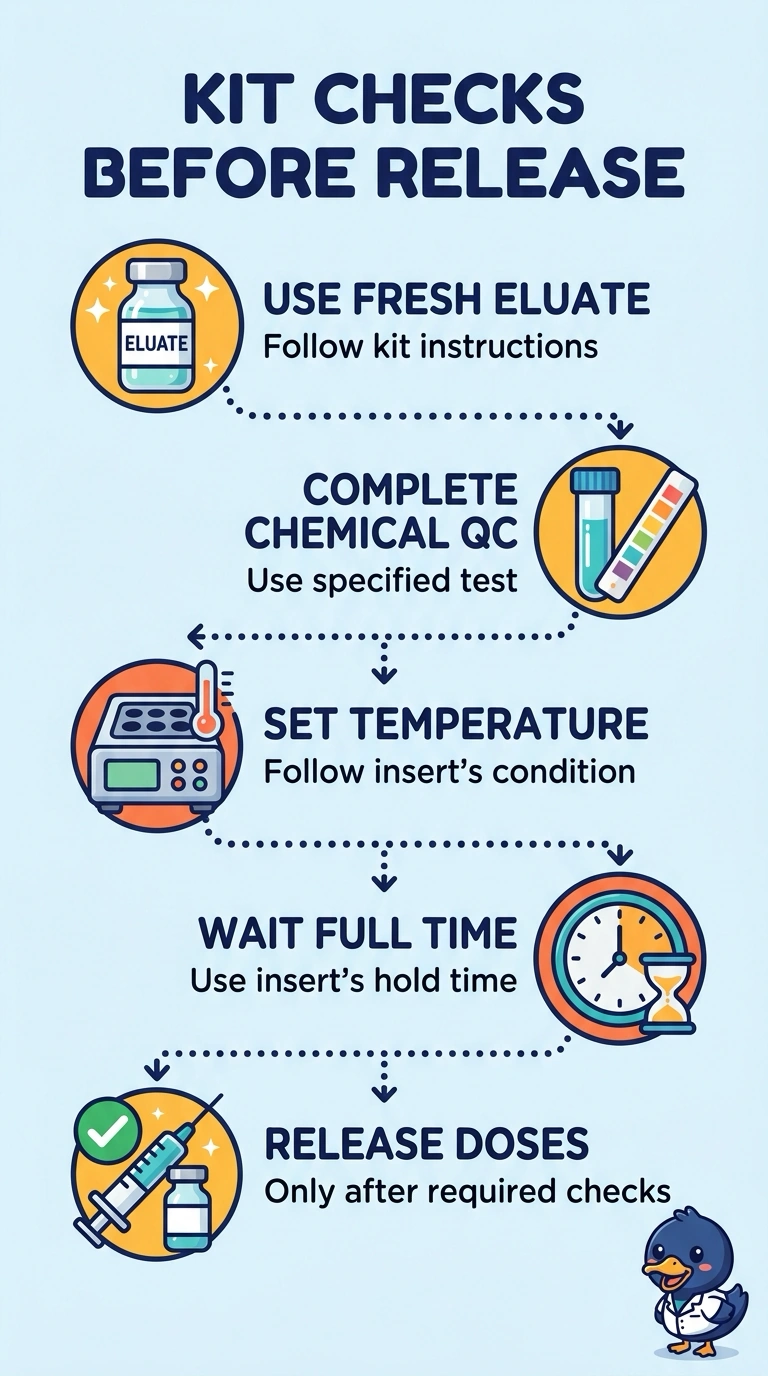
Before you release any dose, complete the required chemical check and meet the insert’s temperature and incubation-time requirements. It’s like checking both the recipe and the timer—looking at the mixture alone isn’t enough.
Full Explanation
The correct approach is to complete the chemical quality-control check and satisfy the package insert’s specified temperature and incubation time before releasing any dose. These are complementary preparation requirements: the chemical check verifies the required product-specific chemical criterion, while the specified holding conditions ensure the kit has undergone the prescribed preparation process. Meeting only the temperature and time requirements is a quality-control omission; without the chemical check, a required release criterion remains unverified. Completing the chemical check but dispensing before incubation is finished is premature release, because the specified preparation period has not elapsed. Completing the check and incubation at a different temperature is a temperature-deviation approach; it does not meet the insert’s stated conditions, even if the other steps were followed. Exam caveat: the specific chemical test, temperature, and incubation time are product-dependent, so do not assume that a particular test such as pH or a standard temperature applies to every kit. Practical check: before dispensing, compare the preparation record with the applicable insert or procedure and verify that the required chemical result, holding temperature, and full incubation time are documented and acceptable.