
A 58-year-old patient with a well-differentiated metastatic midgut neuroendocrine tumor returns for staging before therapy planning. The physician wants somatostatin receptor density mapped in one high-resolution whole-body acquisition. Which radiopharmaceutical should be ordered for this tumor imaging study?
Select an answer to reveal the explanation.
Short Explanation
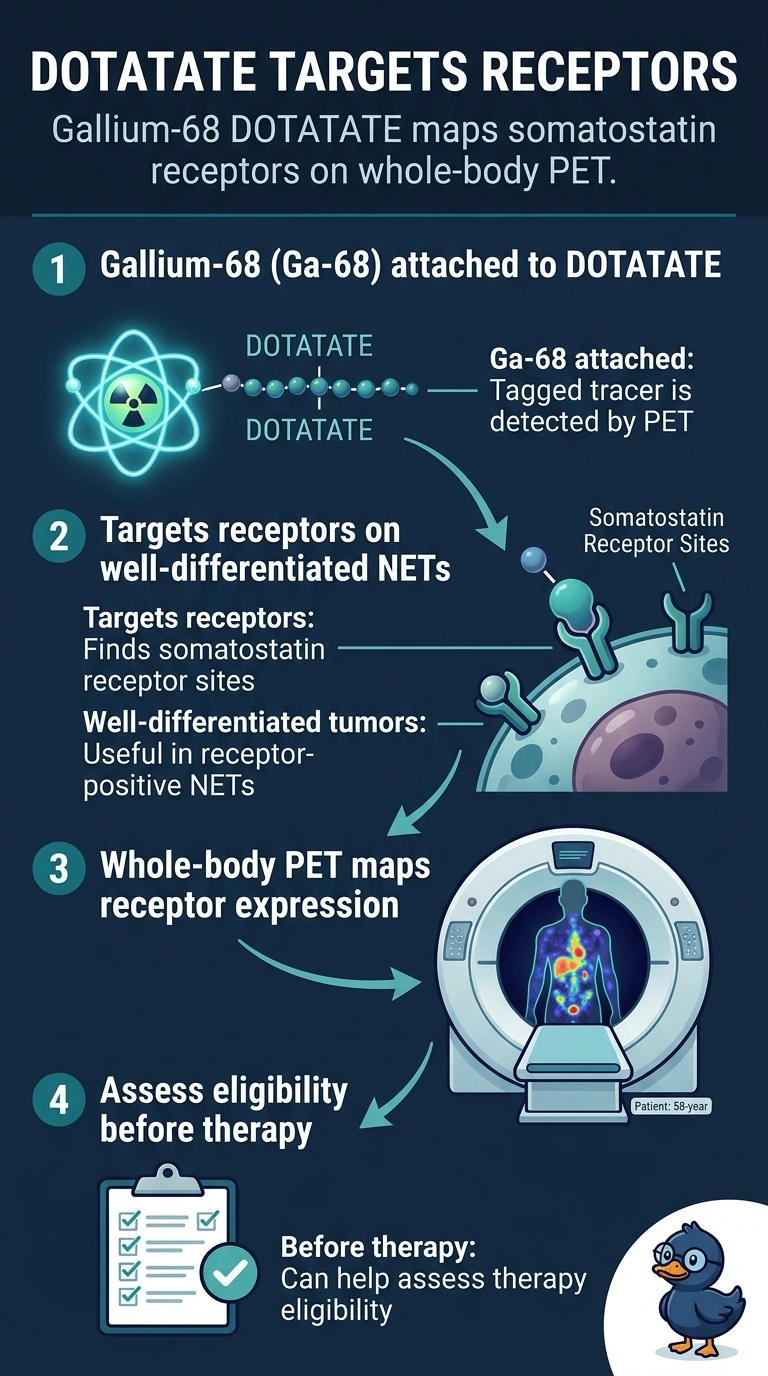
Your goal is to map the tumor’s somatostatin receptors, like matching a key to its lock. Gallium-68 DOTATATE binds those receptors and shows their distribution on a high-resolution whole-body PET scan.
Full Explanation
Gallium-68 DOTATATE is a somatostatin-receptor PET radiopharmaceutical: it binds SSTRs, commonly abundant on well-differentiated midgut neuroendocrine tumors, and provides high-resolution whole-body mapping in a single PET acquisition. This directly addresses both the requested target and imaging format. Fluorine-18 FDG PET is a valid whole-body staging method, especially for aggressive, high-grade, or poorly differentiated disease, but it maps glucose metabolism rather than somatostatin-receptor density; it therefore misses the specific biologic target sought here. Fluorine-18 fluorodopa PET is also used to localize and stage neuroendocrine tumors, including midgut primaries, but reflects amino-acid precursor uptake and decarboxylation, not SSTR expression. Indium-111 pentetreotide binds somatostatin receptors and can assess receptor-positive disease, but conventional planar or SPECT imaging does not meet the requested high-resolution PET acquisition. Exam caveat: a well-differentiated tumor may still show limited DOTATATE uptake if receptor expression is low or heterogeneous, so imaging phenotype should be interpreted alongside pathology and clinical context. Practical check: confirm the requested study is SSTR-targeted PET/CT and that the tracer is DOTATATE before ordering.