
A 77-year-old outpatient finishes a whole-body bone scan, and while checking the delayed images the technologist spots an unexpected focal finding in a weight-bearing bone that the team would want acted on today. The patient is dressed and ready to leave, the ordering physician is in clinic, and department policy requires closed-loop communication for urgent findings. Which communication approach meets that requirement before the patient is discharged?
Select an answer to reveal the explanation.
Short Explanation
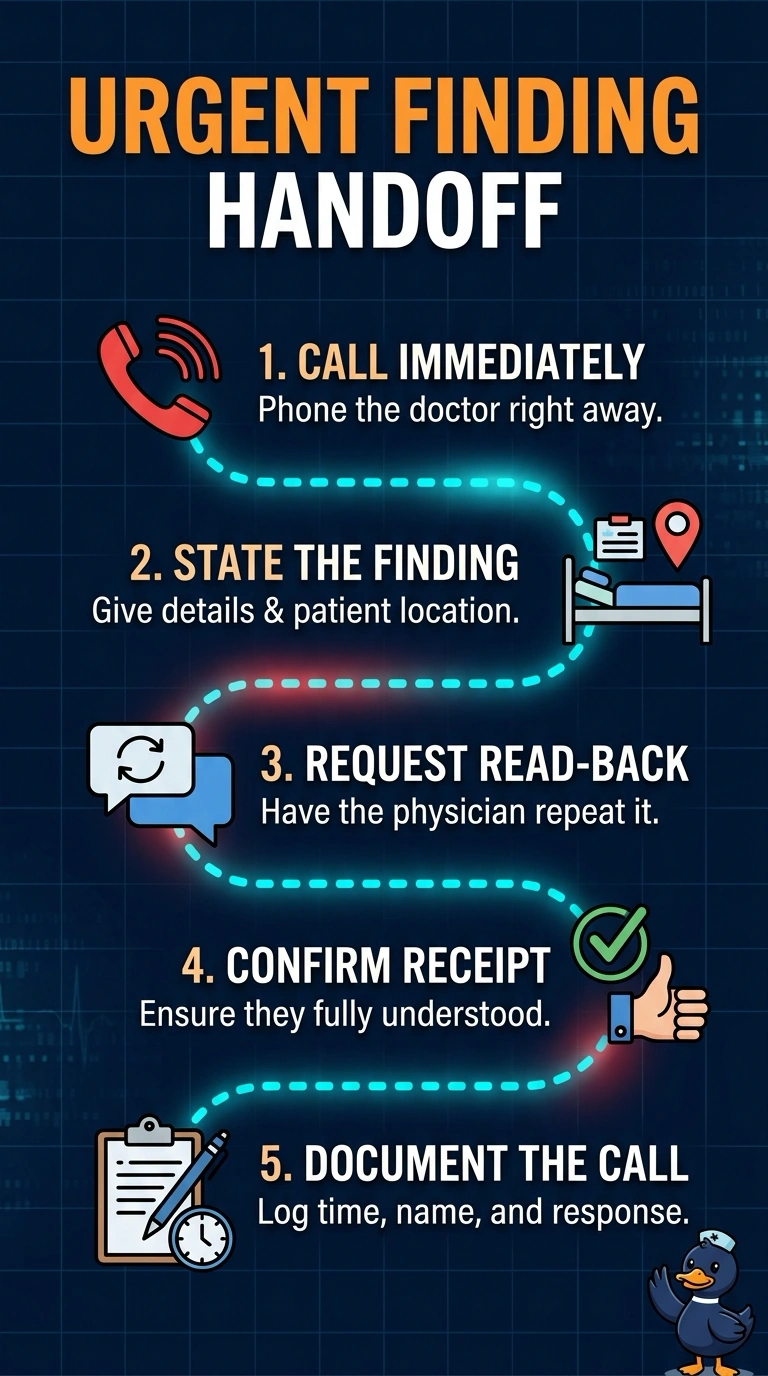
Once you spot a finding that needs action today, the clock starts, and a note nobody has read yet won’t stop the patient from leaving. Calling the interpreting physician, giving the finding and patient location, and hearing the details repeated back makes the handoff verifiable. You meet the closed-loop requirement by confirming receipt and documenting the time and recipient’s name.
Full Explanation
Calling the interpreting physician immediately, giving the specific finding and the patient’s location, requesting a read-back, and documenting the time and recipient’s name meets the closed-loop requirement before discharge. This confirms that the urgent information reached the right person while the patient is still present, and creates a record of who was notified and when. Giving the finding and location and obtaining a read-back, but omitting the recipient’s name and time from the record, prevents reliable verification and audit of the communication. Documenting the contact time and name and giving the finding and location, but accepting acknowledgment without a read-back, does not verify that the critical information was accurately received; a transmission or understanding error could go undetected. Calling immediately, requesting a read-back, and documenting the time and physician’s name, but not stating the patient’s location, leaves out information the team may need to identify or reach a patient who is ready to leave. Exam caveat: “closed loop” requirements can vary by local policy, so follow its specified recipient, confirmation method, and documentation fields rather than assuming a message or general acknowledgment is enough. Practical check: before ending the call, verify that the physician can identify the patient and location, accurately repeats the critical finding, and is documented by name and time.