
A 70-year-old with castration-resistant prostate cancer has a rising PSA after prostatectomy, and the physician wants a PET study that can show small-volume recurrent soft tissue and nodal disease at low PSA levels. Which agent and patient preparation pairing best fits the request?
Select an answer to reveal the explanation.
Short Explanation
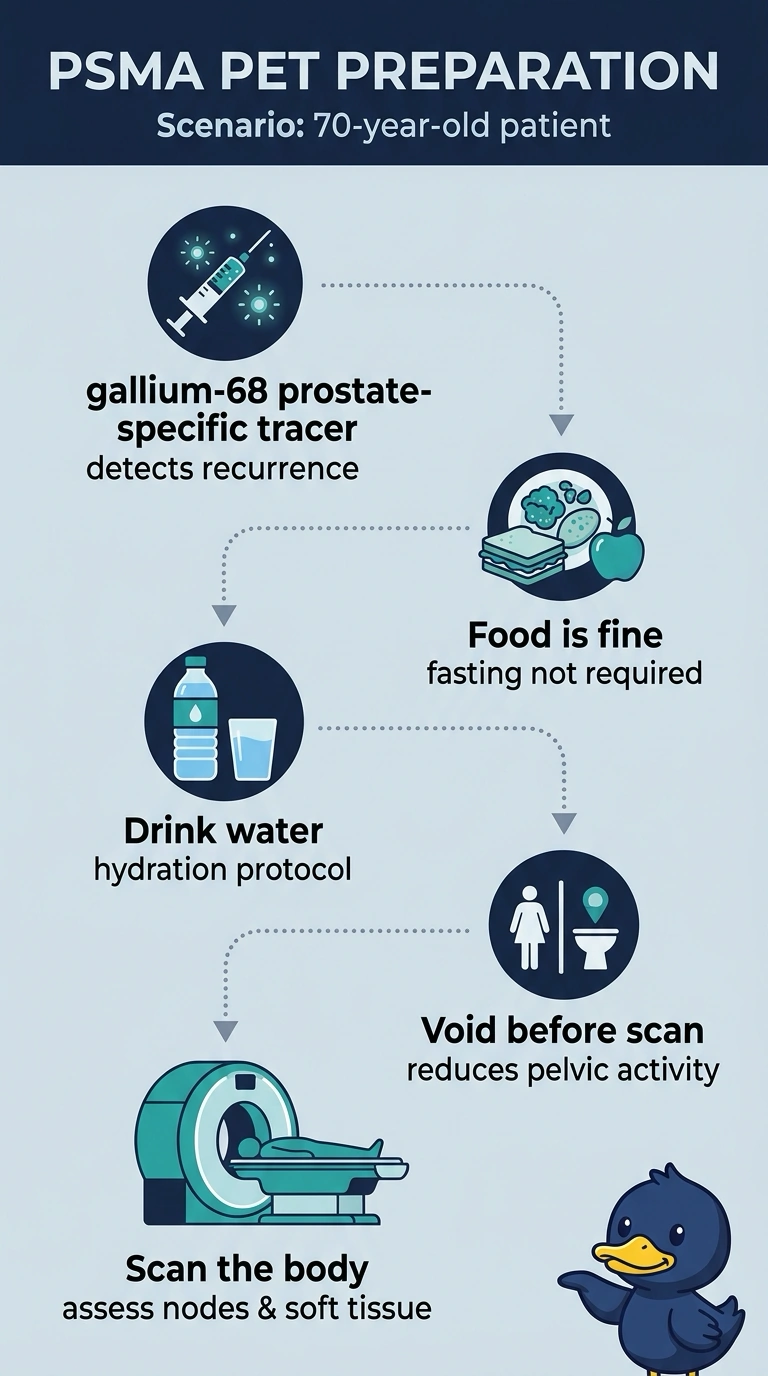
You’d choose a gallium-68 PSMA tracer, which can detect small recurrent prostate cancer deposits even when your PSA is low. Hydrating and emptying your bladder before the scan helps keep urinary tracer activity from hiding pelvic disease, like clearing a smudged window so you can see what’s behind it.
Full Explanation
Prostate-specific membrane antigen is overexpressed on most prostate cancer cells, so a gallium-68 PSMA tracer can detect recurrent nodes and soft-tissue deposits, including at low PSA levels, which fits the request after prostatectomy. Preparation stays modest: follow the specific agent's instructions; hydration and voiding before imaging may help reduce urinary activity that can obscure pelvic recurrence. Fluorine-18 FDG reports glucose metabolism and can be useful for aggressive or poorly differentiated tumors and lymphoma, but it is not the preferred tracer for typical low-volume prostate recurrence. A somatostatin analogue targets receptors characteristic of neuroendocrine tumors, so its hydration preparation does not make it the right agent for this indication. A technetium-99m MDP bone scan remains useful for osseous disease, yet it is not the PET study requested and does not evaluate nodal or soft-tissue recurrence as a PSMA PET study can. Exam caveat: agent choice follows tumor biology, so confirm the indication before selecting the tracer. Practical check: verify the prescription, the agent on hand, and the preparation instructions you give the patient.