
A patient with a markedly reduced ejection fraction and a large prior infarct is being evaluated for revascularization, and the cardiologist needs proof that the poorly contracting territory still holds living muscle. The patient cannot complete treadmill exercise. Which viability protocol should be planned?
Select an answer to reveal the explanation.
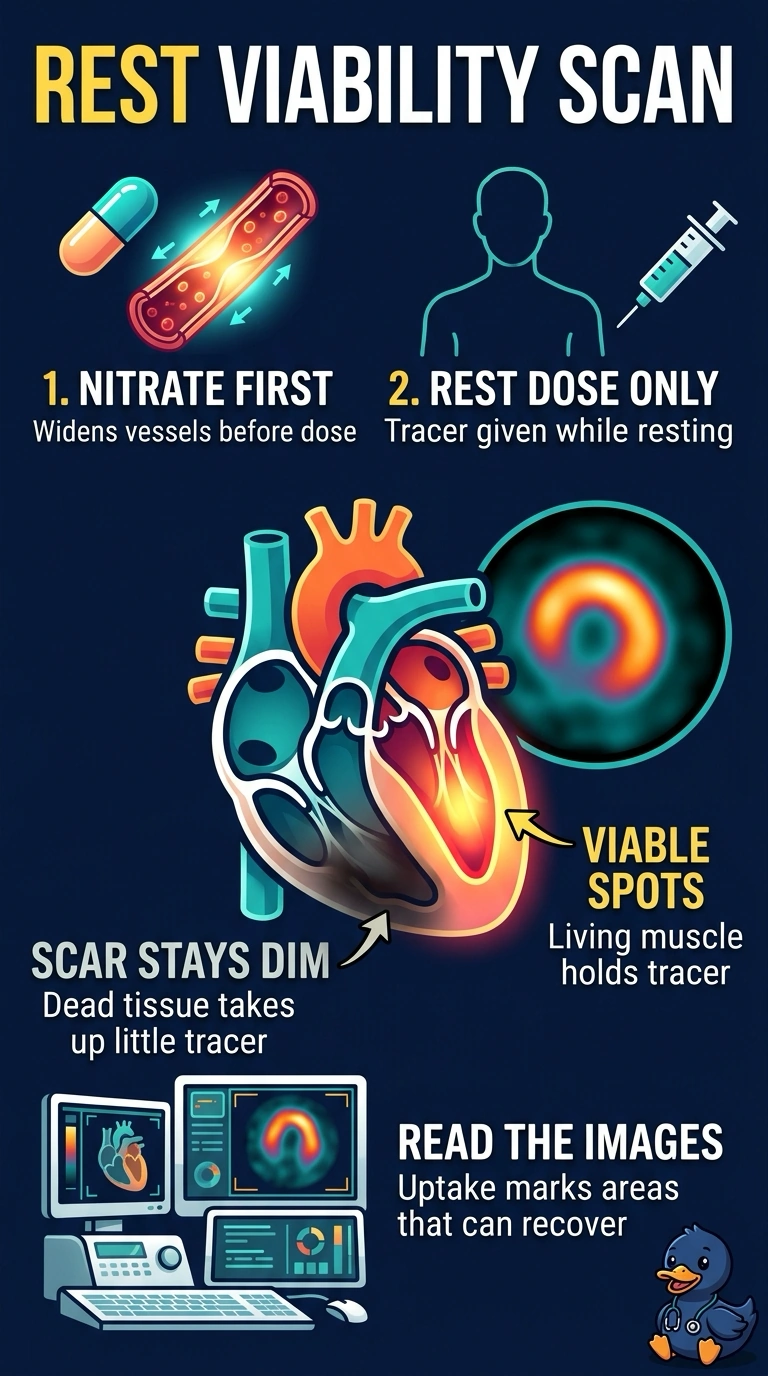
Short Explanation
Tracer uptake is your proof of living cells, because scar tissue simply cannot pull the tracer in. Giving the rest dose after a nitrate widens the vessels and lifts subendocardial flow so hibernating muscle shows up. It is like turning up the water pressure to see which pipes still run.
Full Explanation
The correct protocol is nitrate-enhanced rest perfusion imaging. Nitrates dilate coronary vessels and can improve tracer delivery to viable myocardium in a dysfunctional, hypoperfused territory, making residual living muscle more apparent against a large fixed defect. This directly addresses the need to establish viability and does not depend on treadmill exercise. A standard rest perfusion study without nitrate is a routine acquisition, but in a severely underperfused viable segment tracer uptake may remain low; omitting the nitrate preparation loses the specific enhancement the question calls for. Vasodilator stress perfusion is useful for assessing inducible perfusion abnormalities, but stress tracer distribution alone does not reliably distinguish scar from viable dysfunctional myocardium, so it does not answer the viability question. Gated rest SPECT provides useful information about motion and thickening, yet functional impairment can persist in viable myocardium; motion-based interpretation alone cannot establish that the poorly contracting territory is scarred or living. Exam caveat: nitrate-enhanced uptake supports viability but should be interpreted with the full clinical and imaging context, and nitrates may be unsuitable in some patients, such as those with significant hypotension. Practical check: confirm nitrate eligibility and ensure the nitrate is administered with the correct timing relative to tracer injection and image acquisition.