
A 61-year-old with exertional chest pressure is booked for a one-day rest and stress myocardial perfusion study with Tc-99m sestamibi, because the cardiology clinic can see the patient only once this week. Rest images are acquired first, and the patient returns the same afternoon for a treadmill stress stage with a second injection. Which injection sequence and relative activity fits this one-day sestamibi protocol?
Select an answer to reveal the explanation.
Short Explanation
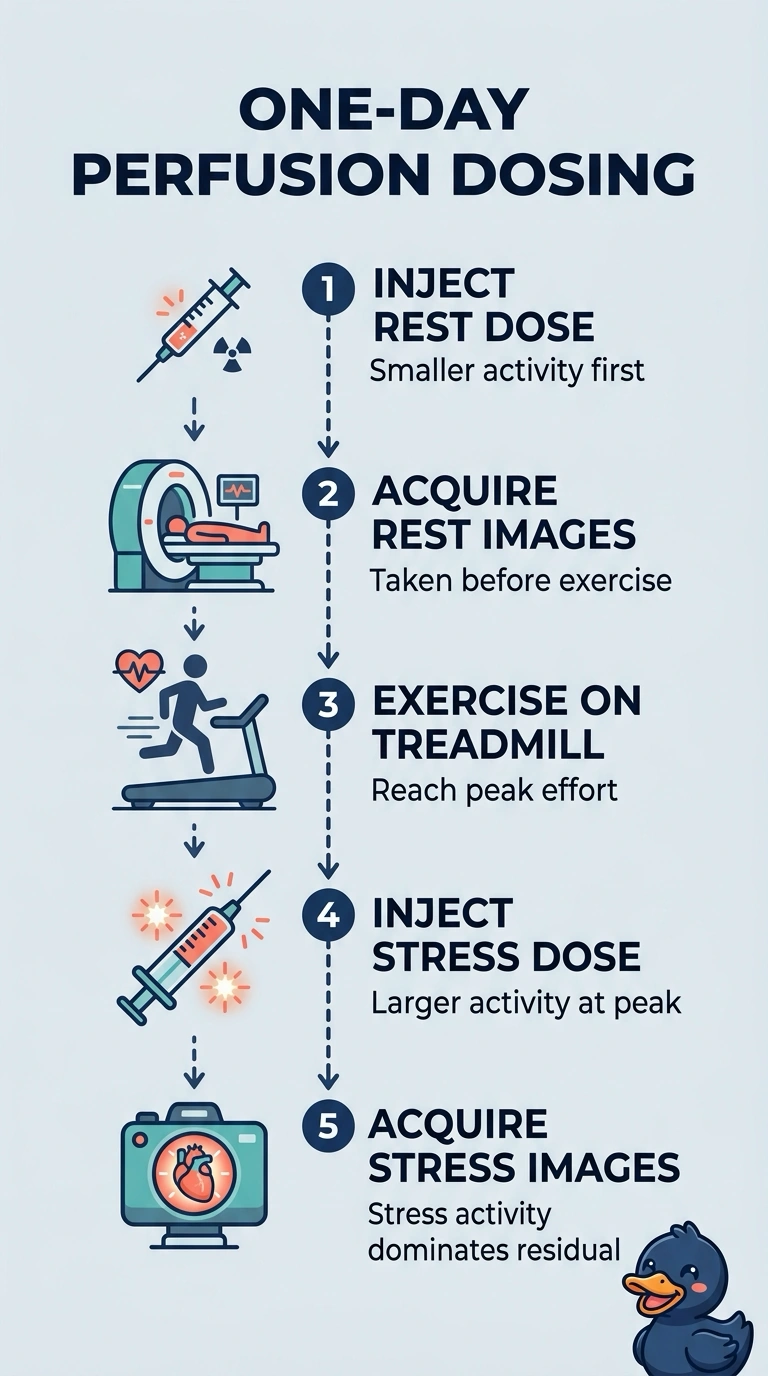
You give the smaller sestamibi activity at rest first, then the larger activity at peak treadmill exercise. It’s like turning up the stress signal so it stands out from the leftover rest activity in a one-day protocol.
Full Explanation
In a one-day rest and stress study, the same tracer is injected twice hours apart. Because sestamibi is retained in the myocardium, activity from the rest dose remains when stress images are taken; giving the rest dose smaller and the stress dose larger lets the stress phase dominate the residual rest counts. Equal activities are commonly used in two-day protocols, where decay between days reduces residual rest activity. The reversed-ratio approach makes the stress dose the weaker set, potentially compromising the stress images. A single injection cannot represent two different flow states because sestamibi shows minimal redistribution. Exam caveat: exact activity ratios vary by protocol and camera, so hold to the principle that same-day stress activity exceeds rest activity. Practical check: verify each syringe's activity, volume, and calibration time, inject the stress dose at peak effort, and confirm rest images are complete before exercise.