
A 30-year-old with a transplanted kidney is scheduled for a diuretic renogram. The study must show the tracer arriving and moving through the renal pelvis during the first two minutes with near-second timing, then continue long enough to watch drainage after the IV diuretic given at about twenty minutes, and the curves must be quantitated from defined time frames. Which gamma camera acquisition mode and framing plan fits this renogram?
Select an answer to reveal the explanation.
Short Explanation
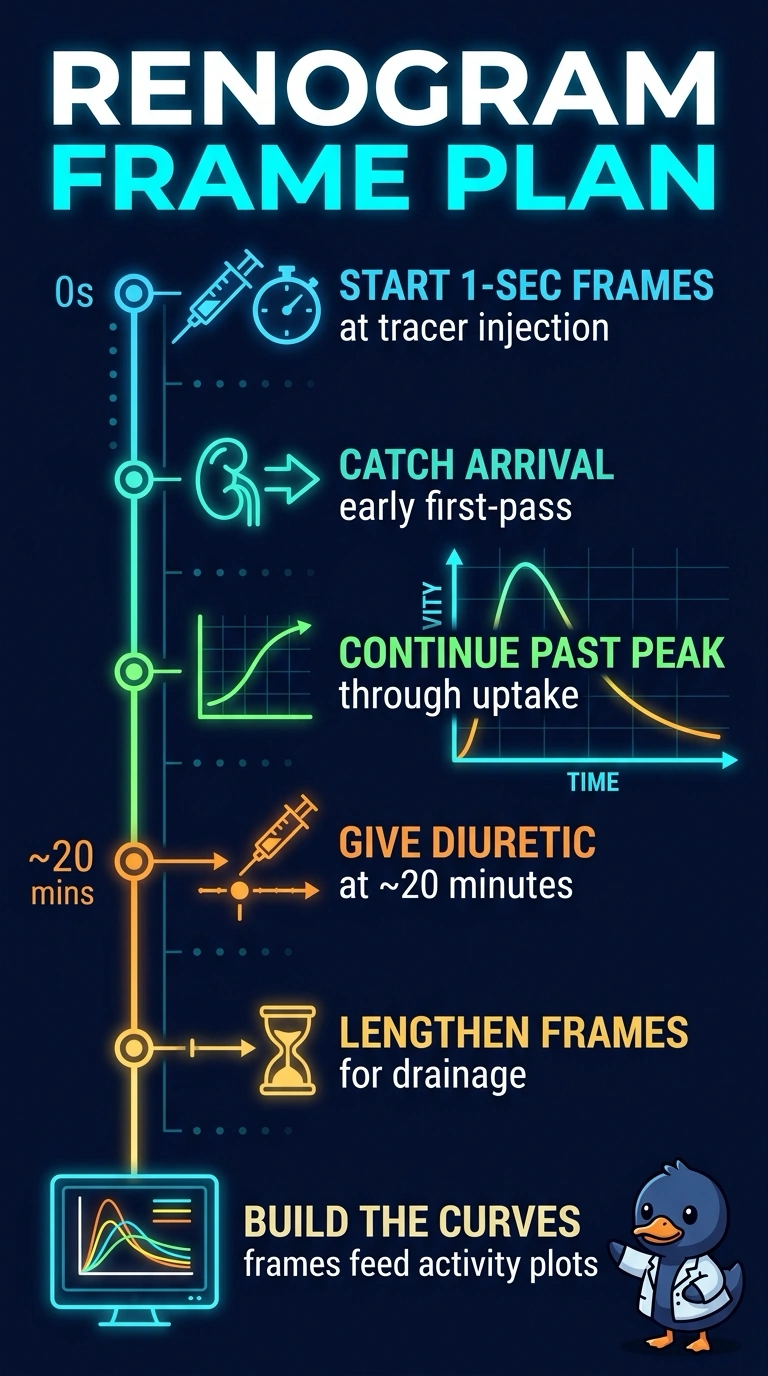
Choose dynamic acquisition with one-second frames during tracer arrival, so you can follow the rapid movement through the renal pelvis. Then use longer frames through the diuretic phase after furosemide at about twenty minutes, while retaining the timing needed for quantitated curves.
Full Explanation
A dynamic frame sequence with one-second frames during tracer arrival, followed by longer frames through the diuretic phase, provides the needed temporal detail for rapid changes in renal perfusion and pelvic activity without generating excessive data throughout the study. Continuing after furosemide at about twenty minutes lets you assess drainage response, and defined frames allow reproducible time-activity curves. A study that gives furosemide at ten minutes uses a recognized F+10 protocol, but conflicts with the specified timing of about twenty minutes and may assess drainage in a different phase. Five-second frames during the first two minutes do not provide the required near-second resolution, even when acquisition continues after furosemide at twenty minutes. One-second early frames followed by longer frames meet the timing and framing needs, but visual review alone does not provide the required quantified curves. Exam caveat: F+10 and F+20 protocols are both used clinically; follow the timing specified rather than treating either as universally correct. Practical check: confirm the template captures the early frames, continues adequately after the diuretic, and saves frame timing and renal regions of interest for generating curves.