
Morning checks on a SPECT system show uniformity within tolerance and a correctly positioned photopeak, but a bone tomogram acquired afterward shows structures shifting side to side between adjacent transverse slices. Which camera quality control test should be examined first?
Select an answer to reveal the explanation.
Short Explanation
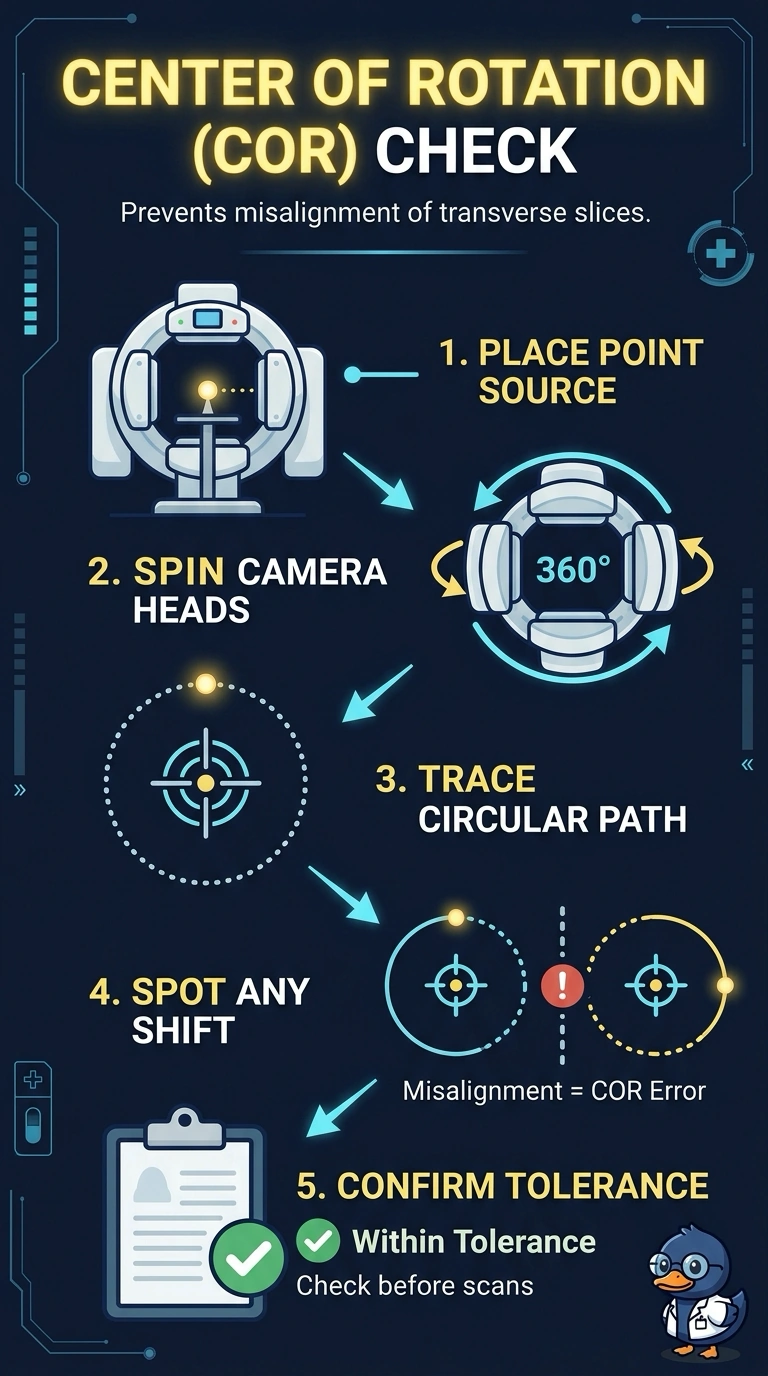
You’ve already confirmed uniformity and the photopeak, so the side-to-side shift points to the center of rotation. Like a slightly crooked axle, an off-center rotation axis can misalign transverse slices, and a point-source check can reveal it.
Full Explanation
Tomographic reconstruction assumes every projection was taken about one axis, so if the detector rotation axis is misaligned, projections can be misregistered and structures can shift between adjacent transverse images. The center of rotation test measures that alignment, commonly using a point source, making it the check that matches a systematic slice-to-slice shift. An extrinsic flood instead tests uniformity, and poor uniformity typically shows as shading or regional count changes rather than misregistration. Retuning the photopeak controls how much scatter enters the window, changing image contrast and potentially resolution rather than the geometry of the projections. A linearity flood finds spatial distortion, such as bar-pattern distortion, within an image rather than shifting whole structures between slices. Systems may report center-of-rotation results in bins or millimeters, so follow the applicable procedure and tolerance. Repeat the test after relevant camera service and confirm the result is within your department's tolerance before clinical use.