
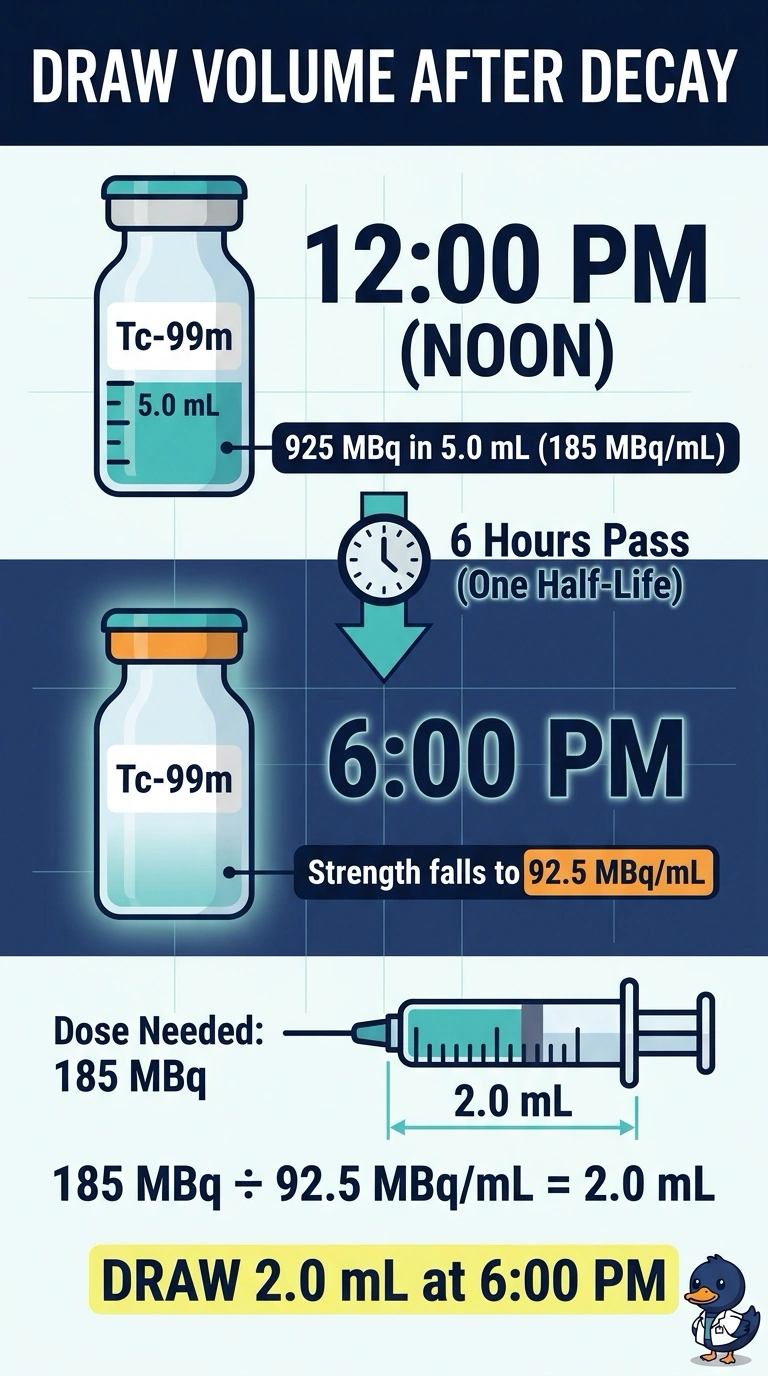
A liver and spleen study requires 185 MBq of technetium-99m sulfur colloid. The unit-dose syringe is calibrated for 12:00 PM and holds 925 MBq in 5.0 mL, a concentration of 185 MBq per milliliter at noon. The appointment moves to 6:00 PM, and the full 185 MBq must be in the syringe at injection. Using technetium-99m's six-hour physical half-life, what volume should be drawn at 6:00 PM to deliver the prescribed activity?
Select an answer to reveal the explanation.
Short Explanation
The activity keeps falling while the syringe sits on the shelf, so you'll work backwards from what you need at injection time. After six hours the strength is half its noon value, meaning the same 185 MBq now sits in twice the volume. Decay correction turns into plain volume math once you know today's concentration.
Full Explanation
Decay reduces activity exponentially, and technetium-99m's six-hour half-life means the syringe concentration falls from 185 MBq per milliliter at noon to about 92.5 by 6:00 PM, so the required 185 MBq needs 185 divided by 92.5, which is 2.0 mL, because drawing volume rises exactly as concentration falls. Activity, volume, and time are tied together, so once you fix two of them the third falls straight out of the arithmetic. The fixed-calibration approach fails because it applies the noon concentration to a later time and delivers only half the prescribed activity. The double-half-life approach fails because it miscounts the elapsed window, overestimates decay, and draws twice too much activity. The whole-unit-dose approach fails because it ignores the prescription and delivers roughly two and a half times the intended activity. Exam caveat: use either the decayed concentration at injection or decay-correct the activity to the calibration time; do not apply both corrections. Practical check: draw the volume, measure it in the dose calibrator, and document calibration time, volume, and measured activity before administration.