
A hospital with no cyclotron or reactor schedules an ordered technetium-99m sestamibi SPECT study with the first patient at 07:00, while its only isotope delivery arrives between 09:00 and 11:00. Which supply arrangement can dose the first patient on time?
Select an answer to reveal the explanation.
Short Explanation
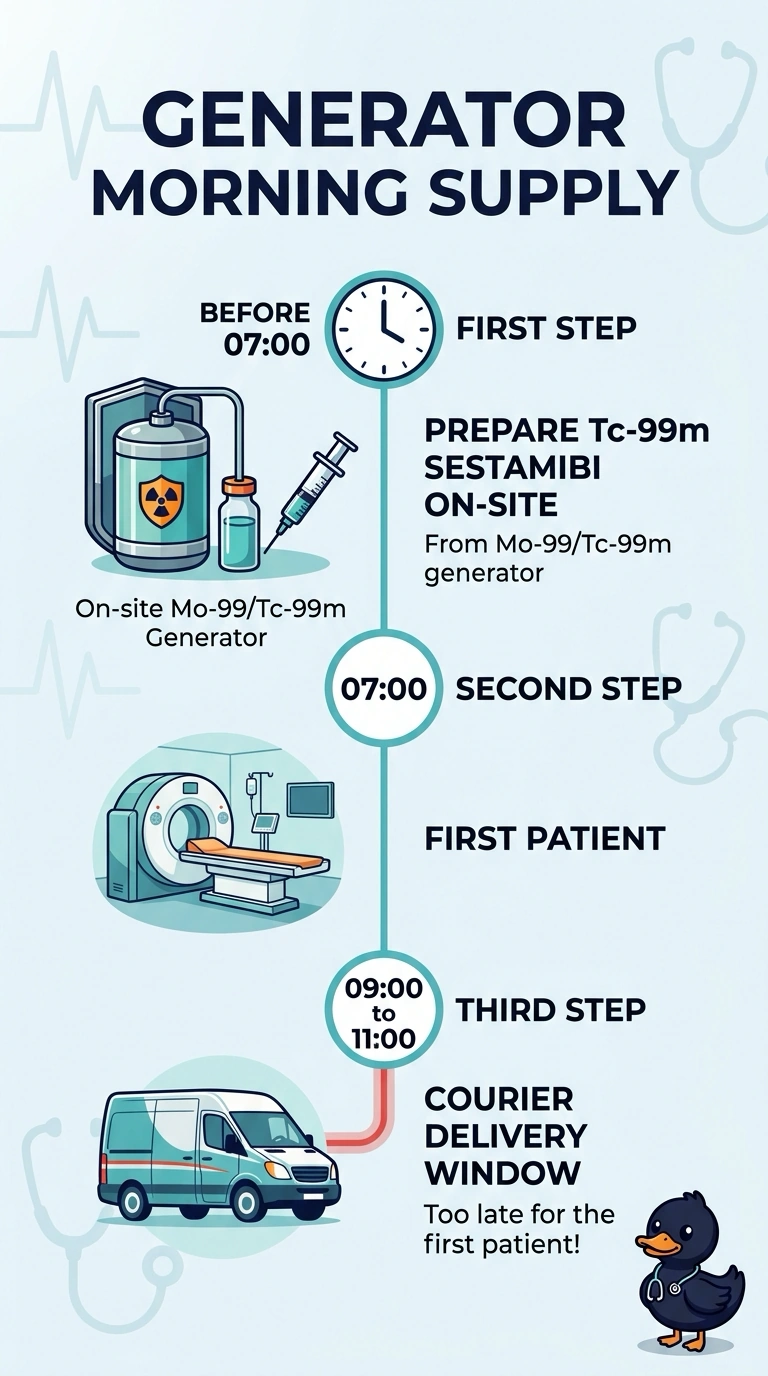
Your generator carries a long-lived parent that decays into technetium-99m inside the column, so you can prepare the dose on site before the first patient. That avoids waiting for a courier window that starts after the appointment. A generator works like a faucet you turn on demand instead of a bottle shipped in advance.
Full Explanation
A molybdenum-99/technetium-99m generator holds a parent that decays inside the column into a short-lived daughter. Eluting the generator and preparing the sestamibi dose according to the kit instructions before 07:00 can support the scheduled injection, ahead of the courier window. Patient-ready unit doses from a central pharmacy are a routine service, but the stated delivery window cannot support a 07:00 injection. Fluorine-18 FDG from a regional cyclotron is a legitimate accelerator-produced radiopharmaceutical, but it does not substitute for the ordered technetium-99m SPECT study. Rubidium-82 from a strontium-82 generator is used for PET perfusion, but it is a different agent and modality from the one ordered. Exam caveat: generators need periodic elution and column replacement, so a backup plan matters when activity drops off. Practical check: confirm the delivery window, the booking sheet, and the elution log before the list starts.