
A patient is referred for whole-body bone scintigraphy with Tc-99m MDP because metastatic disease is suspected. The radiopharmacist notes that the agent binds to bone while unbound activity travels through the kidneys into urine over the next few hours. Which statement correctly identifies the study's target organ and its critical organ?
Select an answer to reveal the explanation.
Short Explanation
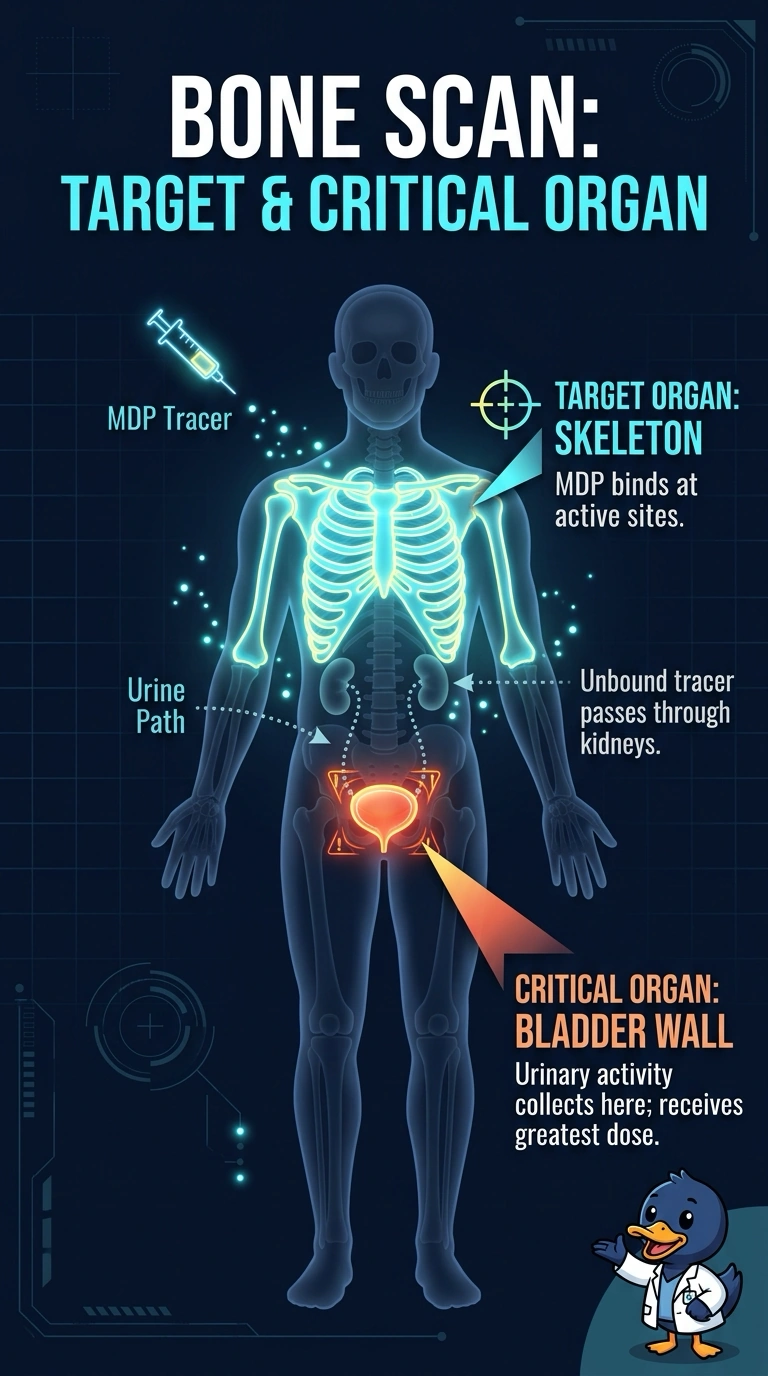
Your target organ is the skeleton—the study is aimed at showing bone, like a map highlighting its main feature. Your critical organ is the bladder wall, where Tc-99m MDP that isn’t bound to bone collects as it leaves your body in urine.
Full Explanation
Tc-99m MDP binds to bone, particularly at sites of active bone turnover, so the skeleton is the target organ: it is the tissue the study is designed to image. The critical organ is a different dosimetric concept—the organ expected to receive the greatest radiation dose under the applicable assumptions. Unbound tracer is cleared through the kidneys into urine, where activity accumulates in the bladder; under usual dosimetry assumptions, this makes the bladder wall critical. The skeletal-target-and-skeleton-critical approach confuses imaging uptake with greatest dose: bone localization does not by itself establish that the skeleton receives the highest dose. The kidney-as-target approach confuses tracer clearance with the purpose of the scan; renal filtration does not make the kidneys the tissue being imaged. The skeleton-target-and-kidneys-critical approach similarly mistakes the kidneys’ role in filtering tracer for the organ receiving the greatest dose; urinary pooling can instead make the bladder wall critical. Exam caveat: the dose to the bladder wall depends in part on bladder filling and voiding, so the critical-organ identification rests on the stated dosimetry assumptions. Practical check: confirm the protocol’s dosimetry assumptions and review the patient’s bladder-filling and voiding instructions.