
A nodule in the lower lung sits just under the diaphragm, and the team wants a time-activity curve from it while the patient breathes shallowly but unevenly. Counts are limited, so image noise should stay low and the data must stay re-sortable after the scan. Which PET acquisition setup preserves the framing, gating and noise advantages this study needs?
Select an answer to reveal the explanation.
Short Explanation
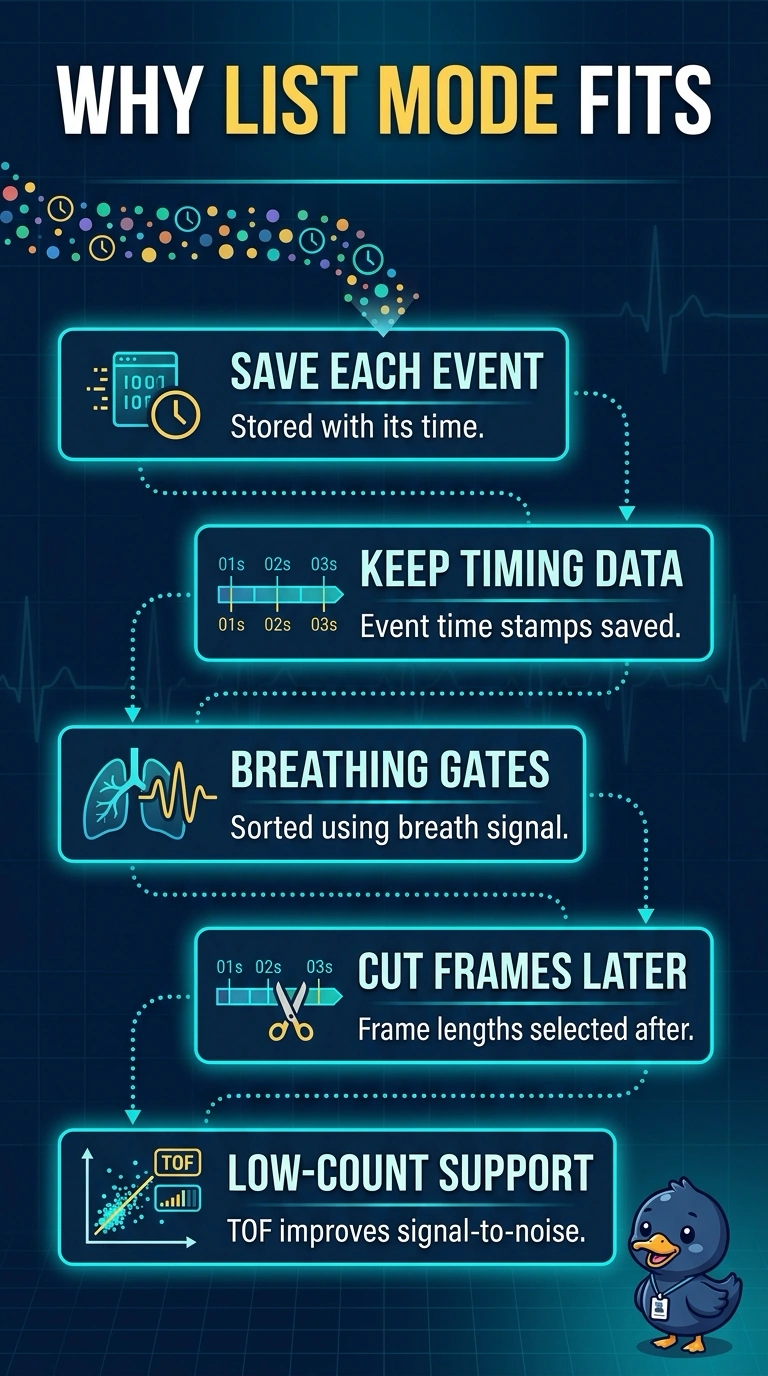
List mode keeps each detected event with its own time stamp, so you can cut frames, sort breathing gates and retain time-of-flight information after the scan. A static frame locks in the timing, and without a recorded breathing signal there is nothing to gate on later. It behaves like shooting in RAW rather than saving a finished JPEG.
Full Explanation
List-mode acquisition preserves event timing, allowing the data to be reframed into a time-activity curve after the scan; recording the breathing signal permits retrospective respiratory sorting, which is useful when breathing is shallow or irregular; and time-of-flight (TOF) information improves localization and noise performance when counts are limited. Short fixed frames with TOF and a recorded trace are a familiar dynamic protocol, but event data have already been grouped into frames, so they cannot be freely re-sorted at the event level after acquisition. List mode with retrospective respiratory gating retains the desired timing and gating flexibility, but omitting TOF gives up a useful noise-reduction advantage in this low-count study. Retrospective data-driven respiratory estimation is also used in PET, but it does not meet the stated requirement to record the breathing signal; moreover, estimating motion from sparse events may be less dependable. Exam caveat: list mode alone does not guarantee a useful curve—frame duration and respiratory-bin choices must balance temporal resolution against counts per bin. Practical check: confirm that the scanner stores list-mode events, the respiratory trace is synchronized and retained, and TOF is enabled in the reconstruction protocol.