
Before the first patient arrives, the nuclear medicine department runs weekly quality control on the well counter and the thyroid uptake probe. The supervisor wants proof that the counting system stays stable during long counts. Which QC test best demonstrates that counting stability?
Select an answer to reveal the explanation.
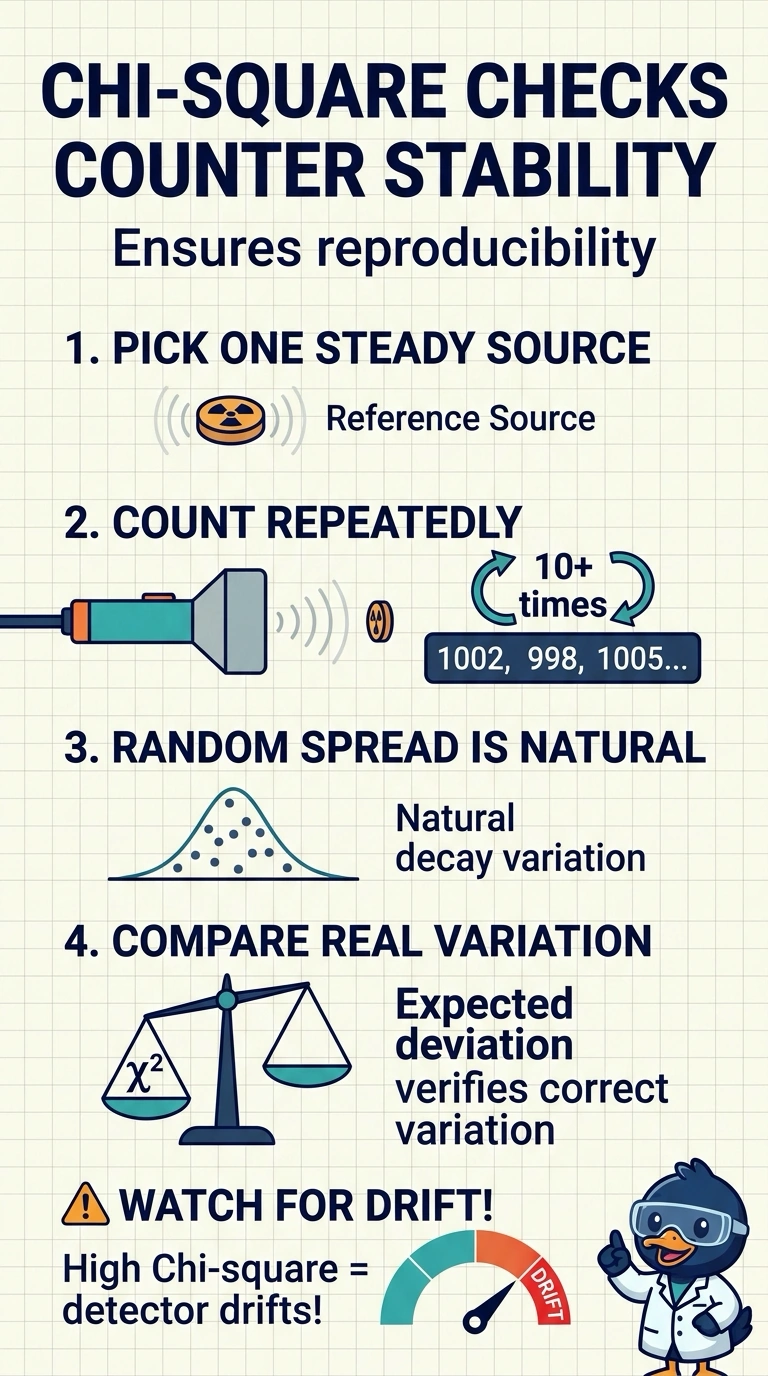
Short Explanation
Chi-square is your stability check: you count one steady source many times and confirm the spread stays within normal counting variation. Photopeak alignment and a background reading each capture only a single moment, so neither shows drift. It's like a bathroom scale that gives a slightly different number every time you step on it.
Full Explanation
Reproducibility testing, usually run as a chi-square check, asks whether the well counter returns the same count rate each time the same source is counted; because radioactive decay is random, some scatter is normal, and the chi-square value tells you whether that scatter stays inside expected statistics or signals an unstable detector, a loose cable, or an intermittent autosampler. Aligning the photopeak on the reference source remains important, but it only confirms that the energy window sits on the isotope's full-energy peak at that instant, not that the system holds that alignment through a long patient count. Measuring background establishes the ambient and shielded count rate you subtract from every assay, yet it is a single snapshot as well. Comparing a sealed standard's known activity with observed counts gives counting efficiency, which tracks sensitivity, but a system can be efficient and still drift. The exam caveat is that QC labels differ between departments, so match the name of the test to the property it actually measures. Practical check: run the chi-square protocol on your own instrument before you trust a low-count patient sample.