
After a Tc-99m pertechnetate spill wets the hot lab bench, the technologist must document both the dose rate a worker stands in and whether the bench holds removable contamination before cleanup. Which pair of measurements gives both the removable contamination result and the dose rate at the workstation?
Select an answer to reveal the explanation.
Short Explanation
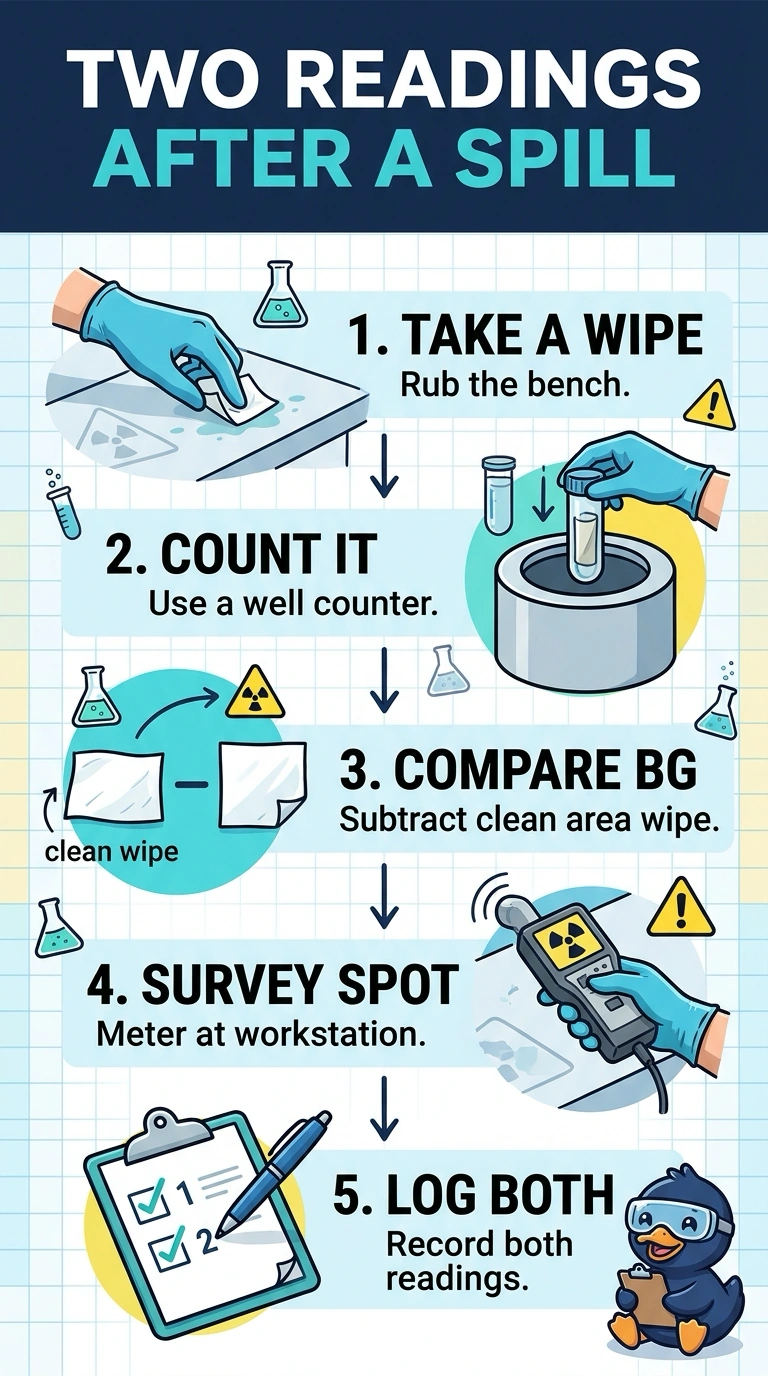
Those two questions need two different tools, so you pair them: a wipe test picks up what can rub off the bench, while the survey meter gives the dose rate where people actually stand. A glove smear only checks the worker, not the bench, and a doorway reading misses the working position. It's the pairing that makes both results defensible.
Full Explanation
Removable contamination and external dose rate are two different quantities, so they need two different tools. A wipe lifted from the surface collects only what can transfer to paper, and counting that wipe in a well counter gives the sensitivity to find activity a hand held meter would miss at a distance; comparing it with a blank wipe shows whether the bench is the source. A survey meter measures the exposure rate in the air, and that reading depends on distance and geometry, so it has to be taken where the worker's hands and torso actually are; a reading at the room boundary describes the area but not the working position. Sweeping the bench with a meter cannot separate fixed contamination from material that lifts off, so it leaves the wipe question open. Sampling gloves instead of the surface documents the worker's risk but says nothing about whether the bench needs cleaning before the next dose is drawn. On the exam, a wipe answers what can come off and a meter answers how much radiation reaches a spot. A practical check: take a background wipe from a clean area and record the meter distance so your numbers reproduce.