
A radiation safety briefing describes a quantity that starts with the energy deposited in tissue from a contaminated glove, then multiplies it by a radiation quality factor so it can be compared with an extremity limit. Which dose quantity does that description match?
Select an answer to reveal the explanation.
Short Explanation
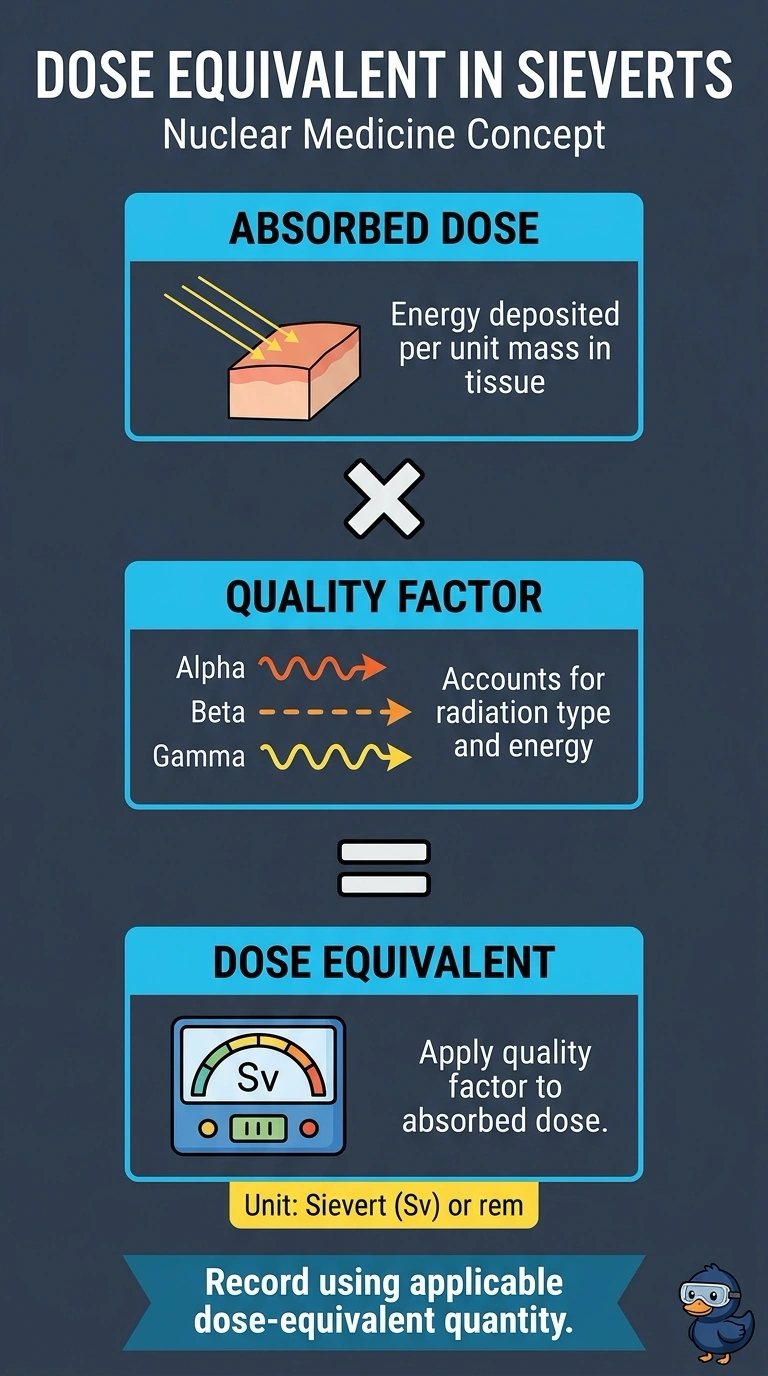
You’re looking for dose equivalent: it takes the energy absorbed in tissue and adjusts it by a radiation quality factor, like applying a weighting scale. It’s expressed in sieverts (or rem) and differs from absorbed dose, which measures energy deposited per unit mass.
Full Explanation
Dose equivalent matches the description because it is calculated from absorbed dose using a radiation quality factor and any applicable modifying factors. In U.S. radiation-protection regulations, extremity limits are specified as shallow-dose equivalent, and dose equivalent may be expressed in sieverts or rem. Absorbed dose in grays reports energy deposited per unit mass but does not include the quality factor, so it does not make the stated adjustment. Exposure in roentgens quantifies radiation-produced ionization in air at the measurement point, not energy deposited in tissue. Effective dose in sieverts applies tissue weighting factors to estimate overall stochastic detriment; it is not the quantity used to assess a local extremity limit. A terminology caveat: ICRP recommendations use “equivalent dose,” while U.S. regulations use “dose equivalent.” As a practical check, look for the quantity that starts with absorbed dose in tissue and applies a radiation quality factor; energy per mass alone indicates absorbed dose, while air ionization or tissue weighting identifies the other listed quantities.