
A patient receives a whole-body absorbed dose high enough to cause radiation-induced nausea and vomiting about four hours later; the symptoms settle by the next day. Meanwhile, a technologist receives repeated low occupational doses over a long career, with a possible long-term cancer risk. Which classification by onset and dose response fits these two scenarios?
Select an answer to reveal the explanation.
Short Explanation
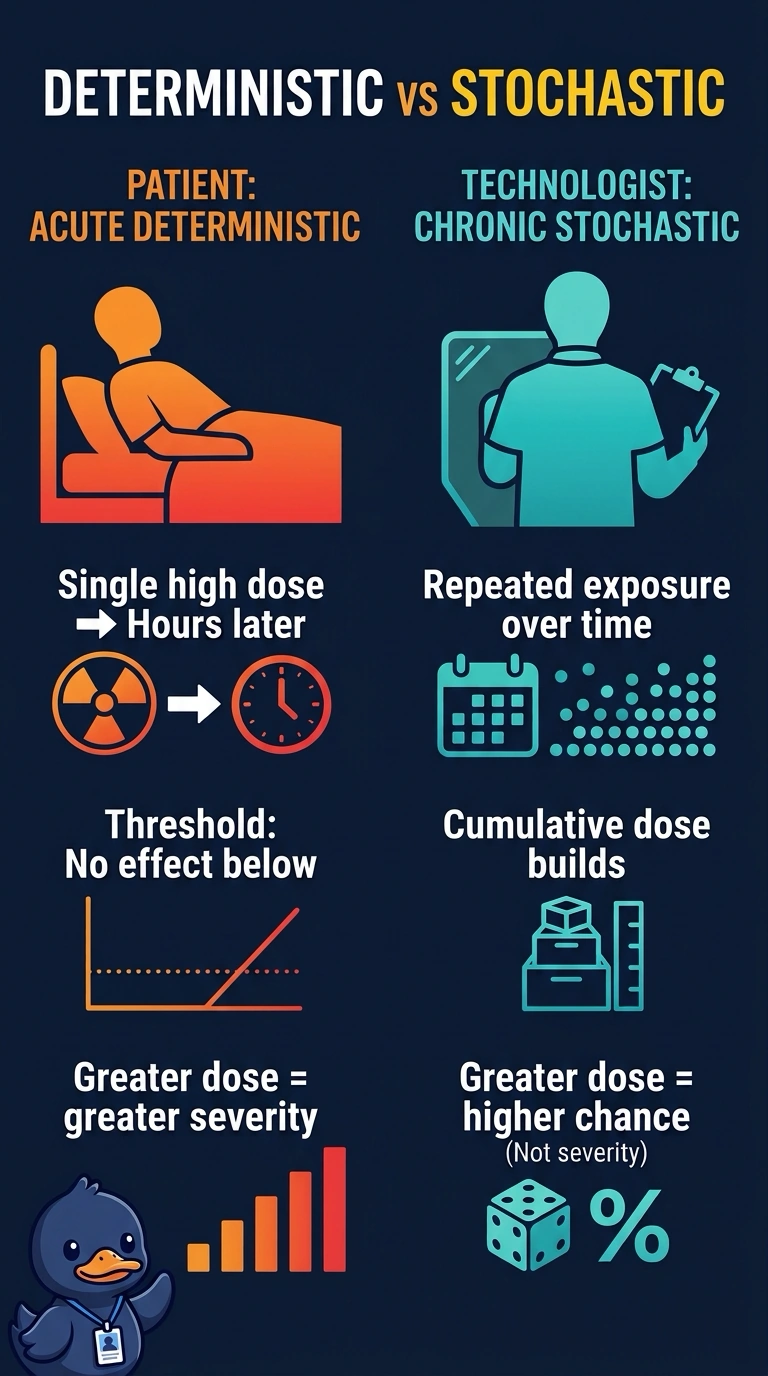
For the patient, you’re seeing an acute deterministic effect: like crossing a threshold, symptoms appear once the dose is high enough, and their severity tends to rise with dose. For the technologist, repeated low doses create a chronic stochastic risk—like buying extra raffle tickets, they raise the chance of cancer, not how severe it would be; timing alone isn’t the distinction.
Full Explanation
The patient’s nausea and vomiting are an acute deterministic effect (a tissue reaction): they follow a sufficiently high whole-body dose, occur within hours, and settle by the next day. Deterministic effects have a threshold, and above it their severity generally increases with absorbed dose. The technologist’s repeated low occupational doses instead carry a chronic stochastic risk, such as cancer. Stochastic effects are modeled as having no threshold for the occurrence of an effect; increasing dose raises its probability, not its severity. Calling the patient’s symptoms acute stochastic and the technologist’s risk chronic deterministic reverses these concepts: nausea after a high dose is a threshold-based tissue reaction, while cancer risk is stochastic. Calling both effects acute deterministic ignores the technologist’s prolonged low-dose exposure and wrongly treats stochastic risk as a deterministic effect whose severity depends only on total dose. Calling both chronic stochastic ignores the patient’s acute symptoms and wrongly classifies the high-dose tissue reaction as stochastic. Exam caveat: “chronic” describes prolonged exposure or course; it does not determine whether an effect is deterministic or stochastic. Practical check: ask whether the effect has a dose threshold and dose-related severity (deterministic) or whether dose changes the probability of an effect (stochastic), then distinguish acute from prolonged exposure.