
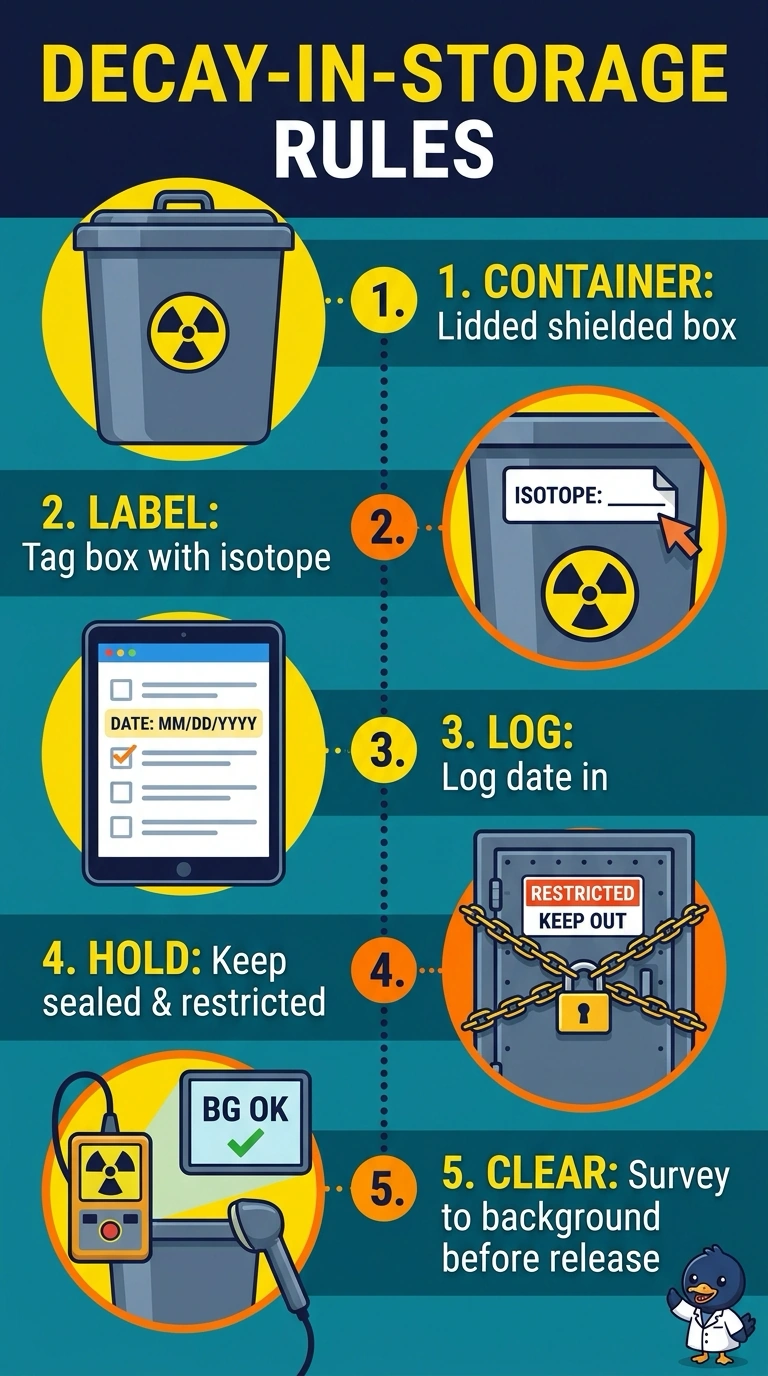
A late Tc-99m kit leaves residual activity in a vial, and a used syringe and contaminated wipe sit in the injection room. Your license lists short-lived laboratory stock for decay in storage, and the procedure requires an isotope and date entry plus a background survey before the container is cleared. Which waste-handling route best follows these radioactive materials rules?
Select an answer to reveal the explanation.
Short Explanation
Radioactive waste doesn't get thrown out on a timer alone; it gets documented and measured out. Keeping everything in a labeled decay-in-storage container until a survey reads background is how you satisfy the license's clearance survey rule.
Full Explanation
Decay in storage is a controlled disposition rather than a waiting habit: material stays in a restricted area until activity falls to background, and the license defines that endpoint through labeling, a log entry, and a measurement. Recording the isotope and date establishes what is in the container and when the clock started, while the background survey supplies objective evidence that the vial, syringe, and wipe may leave controlled space, and both pieces are required because the rule rests on documentation plus verification. Sewer release fails because a short half-life alone never authorizes disposal; the license names which materials may enter the sewer and in what form, so draining the residual vial and discarding the wipe bypasses the assigned route. Elapsed-time clearance without measurement fails because it assumes a source strength and geometry nobody verified, and a missed vial can travel straight to the loading dock. Survey-only disposal fails because a reading without the isotope and date record leaves no traceable documentation, and inspectors ask for both. Exam caveat: hold periods, label wording, and record retention vary by license, so learn the procedure written for your department. Practical check: before clearing the container, look for the label, the log line, and a reading that matches background.