
During check-in for a bone scintigraphy appointment, a patient with asthma and a previous iodinated contrast reaction asks how nuclear medicine differs from the CT she had last month. Department policy requires allergies and prior reactions, pregnancy status, and current medications to be reviewed before the radiopharmaceutical order. Which history review and patient explanation best meets those check-in requirements?
Select an answer to reveal the explanation.
Short Explanation
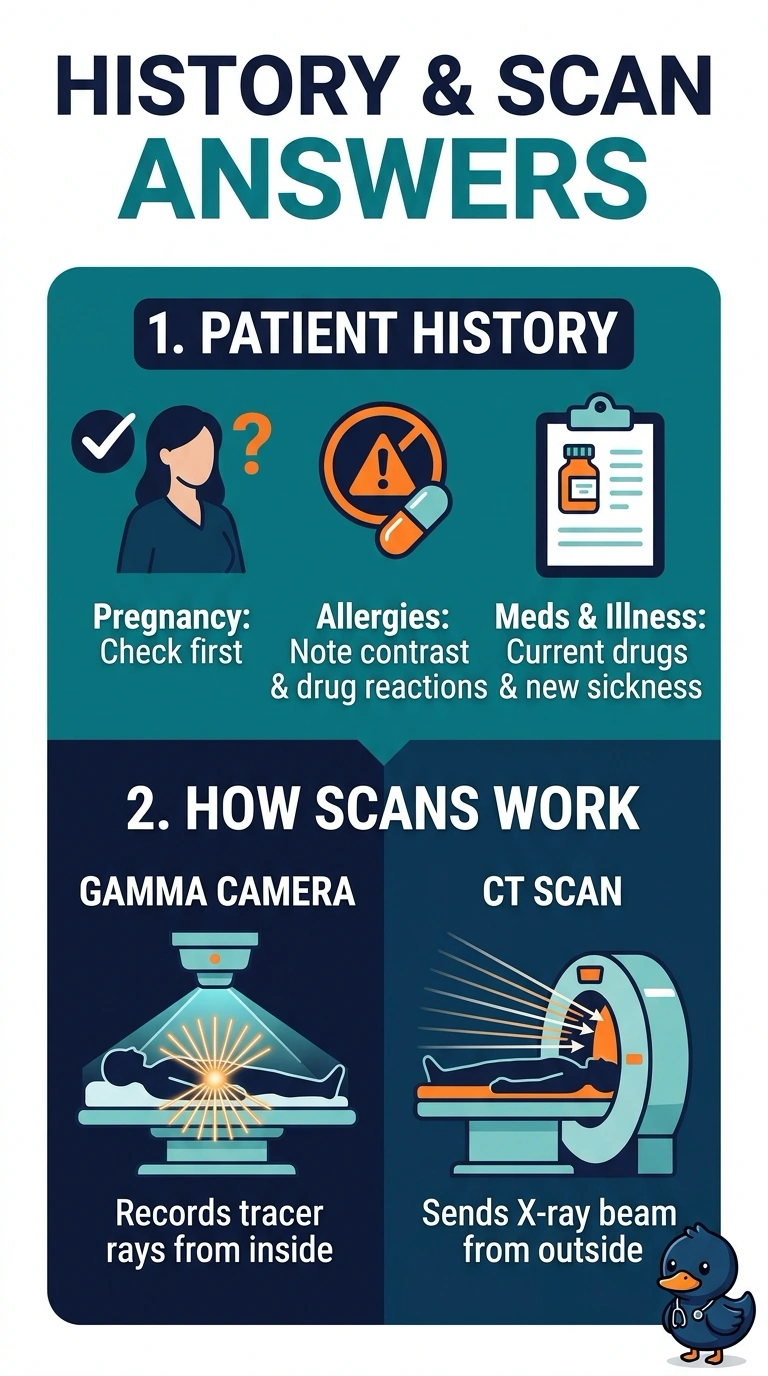
You'll gather the four history fields policy requires— allergies, prior reactions, pregnancy, and medications—then explain the difference in plain language. A gamma camera detects photons emitted by the radiopharmaceutical, while CT sends an X-ray beam from outside her body. Telling her the study works like CT would leave her thinking an X-ray beam is involved.
Full Explanation
A complete history review protects the patient before any radiopharmaceutical is ordered, and the fields policy requires here are allergy and prior reaction history, pregnancy status, and current medications. The reported iodinated contrast reaction should be documented, even though it does not by itself mean that the patient will react to a nuclear medicine radiopharmaceutical. Explain the modality correctly: the radiopharmaceutical is administered, and a gamma camera detects photons emitted from within the body; CT generates X-rays that pass through the patient. Skipping pregnancy status leaves the review incomplete. Pairing a complete history with an X-ray description still fails, because a correct checklist cannot rescue an incorrect explanation. Omitting the allergy and reaction history also fails to meet the stated policy. Confirm the history and explanation before the radiopharmaceutical is ordered.