
Routine quality control on a technetium-99m generator eluate shows molybdenum-99 activity above the permitted level for the amount of technetium-99m present, so the vial is set aside before any dose is drawn. Which explanation correctly identifies the kind of purity failure the eluate has?
Select an answer to reveal the explanation.
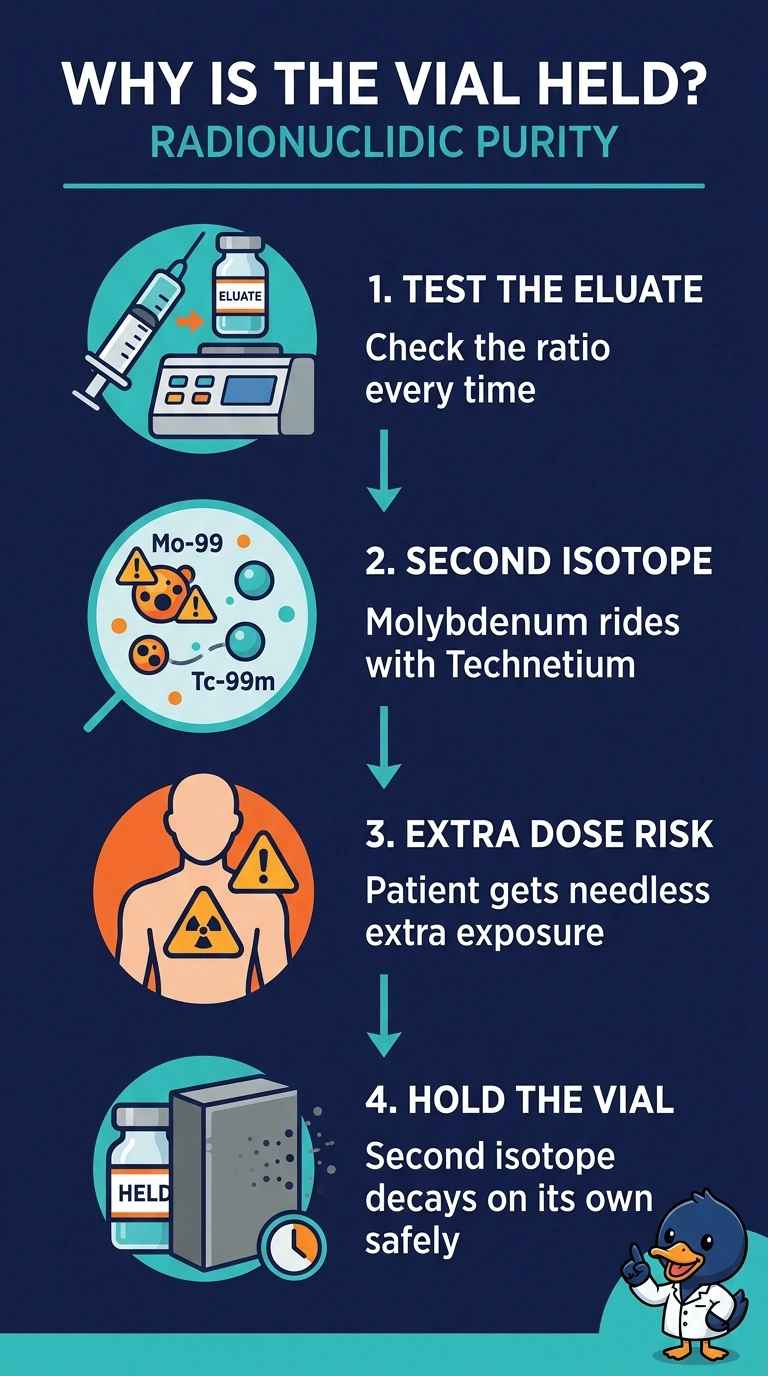
Short Explanation
You’ve got an unwanted passenger in the vial: molybdenum-99 is a radionuclide other than the intended technetium-99m. That makes this a radionuclidic purity failure.
Full Explanation
Radionuclidic purity describes what fraction of the measured activity is actually the radionuclide intended to be there, so the test concerns identity of the nuclide rather than chemical form or total strength. In a generator eluate, molybdenum-99 is a different radionuclide with its own half-life and decay energies, and when it exceeds the permitted ratio the eluate carries activity the patient does not need, adding radiation dose and potentially degrading image quality, so the vial is rightly set aside. Failure of a kit to bind leaves free pertechnetate or hydrolyzed material, which is a radiochemical purity problem because the chemical compound, not the nuclide, is wrong, and the radionuclidic check would still pass. Aluminum ions that break through from the generator column are a chemical purity problem, because they are nonradioactive contaminants judged by a limit test rather than by nuclide identity. A dose calibrator left on the wrong isotope setting produces an inaccurate reading, an instrument problem that changes the number without changing what is in the vial. Exam caveat: the classic separation is one nuclide identity, one chemical form, and one chemical contaminant, so match the failing test to its category. Practical check: read the eluate ratio result and the elution log before releasing the vial for dose drawing.